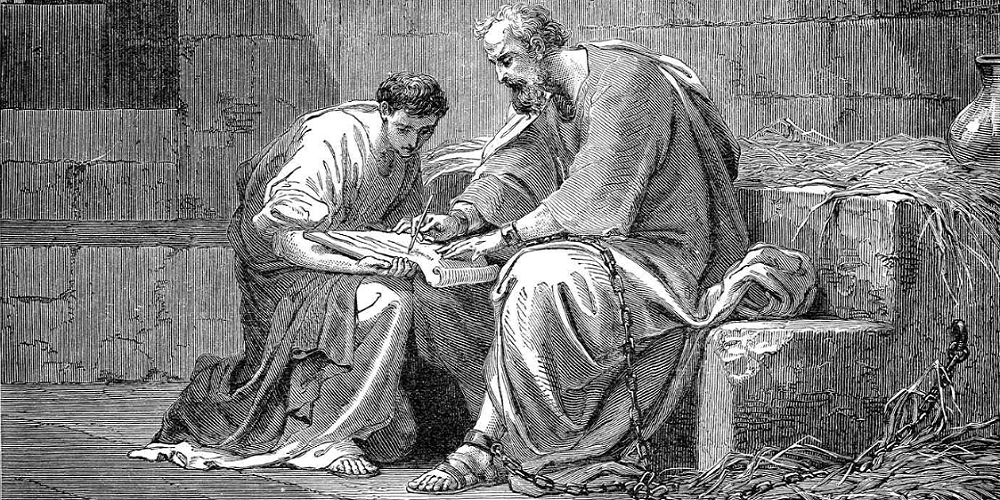
Then the king got up, and with him the governor and Bernice and those who had been seated with them; and as they were leaving, they said to one another, ‘This man is doing nothing to deserve death or imprisonment.’ Agrippa said to Festus, ‘This man could have been set free if he had not appealed to the emperor.’ (Acts of the Apostles 26:30-32)
Is it possible to misplace trust? Let me tell you a personal experience. A number of very close and very sick persons have a visceral, insane hate of yours truly. If it was left to them I would not be writing these lines today. It is sort of TDS but in a smaller scale although equally annoying to me. Ever since I can remember I have been the target of unjustified odium et invidia (it sounds better in Latin) while at the same time (until quite recently) I was completely oblivious to such sentiments in others. Those awful vices are usually cloaked by good manners and even the appearance of affection and altruism. But few can feign such sentiments perfectly.
For those who have seen the movie Amadeus, or studied some of the most complete biographies of Mozart, Antonio Salieri comes to mind as the image of professional jealousy. Salieri, who was himself once a child prodigy, managed to go down in history as a perfect model of a sore loser. The early death of Mozart did not help to improve Salieri’s reputation at all. In fact, some still blame him for the death of the genial composer. [Please watch this small snippet of Amadeus]
You see, Salieri had remarkable talent but he was quite insecure. The roots of his insecurity we do not know about. What we know is that he was a treacherous, jealous, envious SOB. But his forte was his wicked stupidity. How do I know? Because only wicked, remarkably stupid men can be conquered by such obviously ugly vice. A poet once wrote (I dare to attempt a rhymeless translation)
Envy grows like bitter tares
that can poison any field.
One has to be quite alert
ready to uproot its badness,
Yet there is always a man
who invites it to his garden.
Our own great St. Paul was one of those people who were persecuted by many who had no real reason to hate or envy him. The Roman governor Agrippa said of him “This man is doing nothing to deserve death or imprisonment.” In short, St. Paul of Tarsus was a decent, guiltless man but he was also a scholar and a brilliant orator. He was mostly persecuted by mediocre creeps who were not worth the sole of Paul’s sandals. Of him, Our Lord Jesus said once:
“I myself will show him how much he must suffer for the sake of my name.”
With such words Jesus was inviting Paul of Tarsus to the highest throne of Heaven and Earth: the Cross. Envious little men had set up the Cross for Jesus first and now they wanted Paul to hang from it.
Confronted with the possibility of being judged by such creeps, Paul lost sight of his own importance and appealed to Caesar. He could have faced the Sanhedrin in Jerusalem but he decided to appeal to Nero. An Apostle of the Most High was seeking redress from a degenerate Roman Emperor. It was a fatal mistake. Perhaps it was a case of “damned if you do, damned if you don’t” but you and I (with the benefit of hindsight) know there was a third way, the most obvious option: to trust the whole thing to God.
In the end, that glorious, venerable head was cut by mere iron. The man had departed from Jerusalem many years earlier bound for Damascus with letters and chains to capture and imprison the members of the early Christian Church. In the end he wrote his best letters in chains. Those letters were directed to the members of the very Church he once persecuted.
A tradition tells us that his noble head bounced three times after being detached from his body. From those three points, three fountains of pure water burst forth. The Tre Fontane, one fountain for each Person of the Holy Trinity. That spot continues to produce miracles to this day. Bruno Cornacchiola, a former Seventh Day Adventist, had a vision of the Virgin Mary near there. The vision identified herself as Our Lady of Revelation and urged him to enter the true fold of God’s Kingdom on earth. Bruno was a Protestant and a Communist who had plans to kill the Pope. Just like St. Paul had done earlier on the road to Damascus, Bruno did a 180 degree turn becoming an exemplary good Catholic. The envious little men that pushed St. Paul to an early death have not produced much fruit yet. In fact, they’ve been dead twenty centuries. But St. Paul continues to convert people to Christ.
In the days and years to come we may be called to the same place. We may have before us another false option, the Sanhedrin or Nero was Paul’s option. Ours may vary. It is very important to remember there is another choice, one that will give glory to God to the fullest. Meditate on the Prayer of Surrender by Fr. Dolindo Ruotolo where Jesus says:
“Why do you confuse yourselves by worrying? Leave the care of your affairs to me and everything will be peaceful. I say to you in truth that every act of true, blind, complete surrender to me produces the effect that you desire and resolves all difficult situations.”
There is never any need of appealing to a corpse that will sooner or later be food for worms. We have one King that lives forever.
 Quod scripsi, scripsi
Read the previous comment below and meditate on it. It is one of the best comments ever posted here.
LikeLiked by 1 person
RECEIVED VIA EMAIL
North Carolina, USA
Edgy. The book I am reading on the miraculous is quite informative. Luther (or Calvin – one of the early protestant lights) claimed that transubstantiation couldn’t be true because no point could contain the infinite. That is because the protestants were thinking not so much rationally (although they would have used that term) but mechanistically. They saw the infinite as infinitely vast. From a mechanical point of view, you can’t put big into small. But a better definition of infinite would be “not bounded”. The infinite is not bounded by time or space in any way. It is neither unbounded vast nor unbounded small. It is unbounded by any measure. The whole of infinity could be present in a host here and your local church at the same instant because it is not bounded by time, place, distance. For my own amusement I came up with the comparison that the essence of vanilla can be in a million puddings at the same time because although the taste is detected by our taste buds at a place in time, the flavor is the same at any place or any time. The flavor is not bounded by circumstances. It can be fully and completely in each pudding or cookie or cake. It is an analogue of the spiritual.
This ability of the infinite to penetrate the finite is the miraculous. When a miracle occurs, it doesn’t negate the laws of nature as much as it fulfills it. The enlightenment chaps got caught in a category error. Not recognizing, or rather denying the presence of the divine in a mechanistic world, they failed to see that “laws” in nature were not causes but rather concepts derived from observation. An observation can not rule out a possibility unless the observation is infinite – sees all and knows all. Clearly the enlightenment could not see all and know all and yet they began by denying the possibility of miracles simply by assertion because they didn’t like the idea. It interfered with their prerogatives. My favorite definition of heresy from Belloc states that a heretic is he who edits the tradition to suit his references. He doesn’t invent a new religion as much as he truncates an existing religion. Sound familiar?
Something happened in the 1500s. We call it the enlightenment and the reformation, but both represented a heretical movement that denied the miraculous in favor of what really amounts to “works”. It was the revolution of putting man before God. It has made for small, minded and narrow thinking that rules much of reality off limits. It drives envy because it focuses only on the material. It tends toward murder.
LikeLiked by 1 person