The Pharisees and Sadducees came, and to test Jesus they asked him to show them a sign from heaven. He answered them, ‘When it is evening, you say, “It will be fair weather, for the sky is red.” And in the morning, “It will be stormy today, for the sky is red and threatening.” You know how to interpret the appearance of the sky, but you cannot interpret the signs of the times. An evil and adulterous generation asks for a sign, but no sign will be given to it except the sign of Jonah.’ Then he left them and went away. When the disciples reached the other side, they had forgotten to bring any bread. Jesus said to them, ‘Watch out, and beware of the yeast of the Pharisees and Sadducees.’ They said to one another, ‘It is because we have brought no bread.’ And becoming aware of it, Jesus said, ‘You of little faith, why are you talking about having no bread? Do you still not perceive? Do you not remember the five loaves for the five thousand, and how many baskets you gathered? Or the seven loaves for the four thousand, and how many baskets you gathered? How could you fail to perceive that I was not speaking about bread? Beware of the yeast of the Pharisees and Sadducees!’ Then they understood that he had not told them to beware of the yeast of bread, but of the teaching of the Pharisees and Sadducees. (Matthew 16:1-12)
It’s been several decades since the discovery of DNA. Some evolutionary scientists began to notice that the DNA/RNA complex is large collection of information that is passed from generation to generation. A problem arises for evolutionists these days: it is virtually impossible to amass such a large volume of instructions via random mutations. When one considers the moment since Earth became a place suitable for life, there is simply not enough time to form the complex varieties of life around us by blind trial and error. But that is the matter for a future post. (Please see Dr. Stephen Meyer’s Signature in the Cell)
Watching various debates I noticed something interesting. May be this is an irrelevant detail. May be I am creating a tempest in a teapot. Irrelevant or not, it got me thinking. In various conferences I found around the web and in a few personal conversations I observed a reticence, a dislike of the use of metaphors. The source: atheists, dubious mystics, seems to share the same rather unintelligent argument: “I don’t want to hear analogies!” or “Analogies are not valid thought!” When I heard the same from my own brother, a somewhat Catholic individual, I started wondering if perhaps we have before us a new form of distortion.
No analogies, parables, allegories? What?
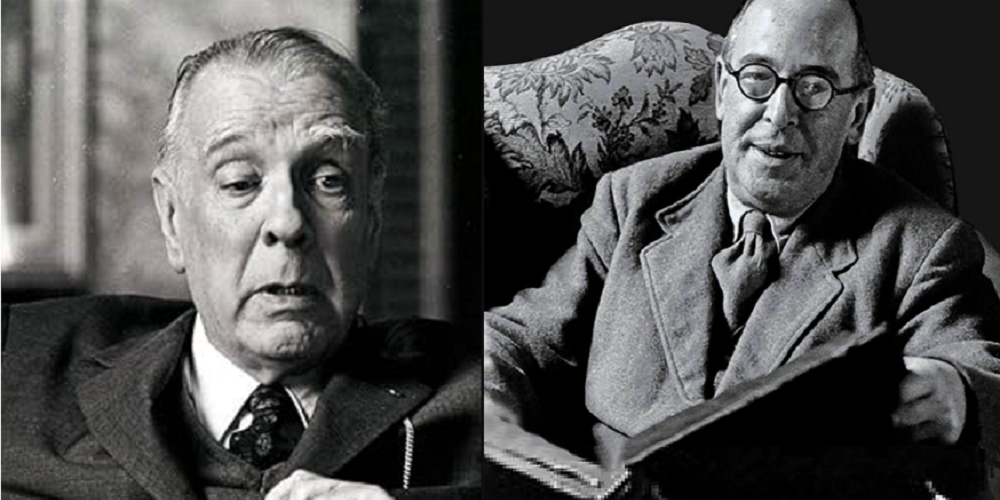
Today I was introduced to a very intelligent article by Robert Keim: The Greatness of Metaphor in the Gospel of Christ. I was immediately reminded of those essays by Jorge Luis Borges on the Kenningar. The Old Norse collection of poetic, figurative devices in which a carefully constructed image replaces a single term. Those Kennings are poetic analogies.
From Beowulf’s: battle-sweat (blood) and the sagas’ sleep of the sword (death); route of the whale (the sea); feast of Vikings (the battle); pig of the sea (the whale)… You get the idea. The Kenningar form a complex system of metaphors that the skilled poet uses in long rhapsodies sometimes avoiding mentioning anything directly at all. Metaphors galore, analogies for every taste!
The C. S. Lewis masterpiece The Discarded Image shows the model of the Universe created by medieval man. The book is a wonderful catalog of notions used by medieval thinkers to assemble a conception of the world that —even if some refuse to admit it— reigned supreme for a good thousand years or more! Within that context, we can see analogies used quite frequently. This leads us back to Robert Keim’s The Greatness of Metaphor in the Gospel of Christ:
“I said on Sunday Christian culture cannot flourish without metaphor. I could make an even stronger statement. I could say that if we consider human life as an eternal rather than earthbound phenomenon, metaphorical thought and expression is superior to—meaning higher in dignity and importance than—the “factual” or “scientific” modes that modernity so diligently cultivates and teaches to children. I might go further again and say that modern society is dangerously confused about what the human mind should be and do: things like metaphor get buried somewhere in “English” class while people assume that high school graduates are well educated if they can apply the quadratic formula, balance chemical equations, and name the organelles in a eukaryotic cell.” (Boldface is mine)
The semiosphere, a universe of meaning
A question surged in my mind: when did all this business of “this is like that” started? Are we living in what Umberto Eco once called a semiosphere? Then the Aleph came to my thoughts one more time. In Hebrew, each of the letters of the alphabet represent a sound but the signification does not end there. Those letters represent numbers and also a variety of concepts like power or some other idea that emerges from the image that is used to represent the letter. The letter Aleph seems to picture a tiny man pointing with one hand up to Heaven and the other hand down towards Earth. It could also picture a plow or and ox’s head. A short list of possible but important meanings could include:
- a comparison or equivalence of Heaven and Earth
- a beginning (because Aleph is the first letter of the Hebrew alphabet)
- God (Who is the beginning of everything and the Owner of all power)
- the power of the plow opening the earth to the reception of the seed
A million possible connections come to mind. Genesis 1:1 being the most obvious but others also that are subtle like Matthew 6:9-13 …

Pray then in this way:
Our Father in heaven,
hallowed be Thy Name.
Thy kingdom come.
Thy will be done,
on earth as it is in heaven.
Give us this day our daily bread.
And forgive us our debts,
as we also have forgiven our debtors.
And do not lead us into temptation,
but deliver us from evil.
And then by extension, in Matthew 16:19 …
I will give you the keys of the Kingdom of Heaven, and whatever you bind on earth will be bound in Heaven, and whatever you loose on earth will be loosed in Heaven.’
Are these two passages of Scripture (both from the mouth of Jesus) some conceptual facet or verbal variation of the letter Aleph? In this case the keys represent power and authority and so does binding. Heaven and Earth are tied by some invisible string.
What have we stumbled upon? (Please comment!) Is it out there a semiotic universe inhabited by elements ordered to represent a sort of complex forest of meaning? Forgive my lack of words to describe what is emerging in my imagination.
We have considered St. Peter’s role in Matthew 16 many times. I have been orbiting that chapter for many years and it keeps producing mysteries that I can barely hold or describe.
The story begins with the Pharisees and Sadducees asking Jesus for a sign. A sign! And here is where it gets interesting when Jesus responds:
An evil and adulterous generation asks for a sign, but no sign will be given to it except the sign of Jonah.’ Then he left them and went away.
Now Jonah was the prophet sent by God to Nineveh. He got aboard a ship going to Spain instead. Later Jonah is thrown overboard and swallowed by a big fish that vomits him near Nineveh. Read again the image of that Scripture:
Old Israel is left standing there while Jesus takes a boat to the opposite shore right after promising them the sign of Jonah! The Messiah’s mission is to teach Israel but he leaves them ashore and navigates with his disciples to the pagan Decapolis area where Greeks and Romans dwell. That act can be compared to Jonah going the opposite way! And then on top of that Jesus says: “I’ll give you the sign of Jonah” and He does exactly what Jonah did. Now, on the opposite side, He choses Peter to be the Prince of the Apostles. Once in Rome, Peter tries to escape persecution but is supernaturally redirected to Rome again by a vision of Jesus going towards the city. There we have another image suggestive of ‘Jonah’s syndrome’.
A specchio, a mirror image
 The concept of Earth mirroring Heaven, suggested by the letter Aleph, now takes shape in the two crosses: that of Christ in Heaven, and the other where Peter offers his life crucified upside down in the Roman Circus. The reflection appears again.
This palimpsest of meaning repeats all over Scripture revealing a depth that can only be deemed as of divine origin.
In Matthew 16 St. Peter seems to play two different kinds of men. The one who walked with Christ in the beginning —‘You are the Messiah, the Son of the living God.’— and the ‘stumbling block’ that works against the Cross: ‘God forbid it, Lord! This must never happen to you.’
In my mind those two instances represent the beginning of the papacy and then the leadership of the apostate Church at the end times. The use of the word ‘satan’ by Christ is not unimportant or meaningless. It points at a time of the eclipse of the Church, the hour of darkness that will envelop the papal institution before the arrival of Christ.
Dear reader, if you can make any sense of this rather disorderly exposition … think of the Cross-Aleph as an instrument that breaks the ground open so that the seed from Heaven can generate life. This is perhaps the most important allegory in the history of mankind!
Very truly, I tell you, unless a grain of wheat falls into the earth and dies, it remains just a single grain; but if it dies, it bears much fruit. (John 12:24)
The body of Christ is that seed regenerating Earth; the “Kingdom of God is like the mustard seed” (Matthew 13:31-32); the Cross is like the plow; Holy Scripture sprouts analogies everywhere because the human mind was created to play the game of ‘this is like that’ over and over. In the few verses we have touched we have seen reflections, images, juxtaposed meanings, all presented to us in a way that can only be an introduction to the multidimensional complexities of the Divine Mind.
Robert Keim: “Christian culture cannot flourish without metaphor!” I dare to add the idea that metaphorical thought is the only possible kind of thought.

 Quod scripsi, scripsi
VIA EMAIL
DALIBOR FROM POLAND
Message-Comment:
Metaphor is one of these devices and one of the fundamental phenomena in language. The word concept fits this. Anić (2000) defines the word conceptual as 1. that relates to notions; abstract and 2. that deals with definitions and relations (not facts) between notions in an area of research. One must also keep in mind that the same author defines the word concept as 1. a draft, a sketch of a written composition or speech that is not rewritten in clean and 2. the conception of an idea, an undertaking or similar; the initial idea, image of some act.
If this is so, metaphor belongs into principles, and each and every metaphor is conceptual in the sense of, by definition, connecting, opening, binding two possibly even unconnectable realities so that one of them, the more avilable one, can be used to describe what is inavailable, what evades description, what is hidden, but also objective because it is not about the subject in its entirety, it is not about us, and it does not come from us.
One can conclude that the spiritual domain of the metaphor is primary. How can one know? Speech that is ordered is predated by thought. The existence of order implies and requires a criterium, a discernment and accord, from the beginning onward. It is a mental effort, not a physical one. That is moral judgement: is something true or false, good or bad, and which is better than the other.1
Considering the metaphors used when speaking of morality, in the work Moral politics and an article that sums it up2, Lakoff says they are closely tied to conservativism and traditional values: family, father as a protector and a solid foundation of moral behavior, which can be a text, institution or a leader of some sort. We add to his thoughts: the Bible is a text – in which we have the Decalogue as well – ten commandments of God, but also the Sermon on the Mount in the New Testament, as well as the moral sense3 of every letter of Holy Writ.
Morals do not exist to be closed in itself and have a small, tucked away piece of space in which it would realize, incarnate. Just as language in its entirety, metaphor, as a small but key part of language, are both connected to linguistic activity, the pragmatic part of language. At the same time sensible, i.e. succinct enough to once in a while being able to describe the indescribable, as, for example, a broken heart does. The heart is here not an organ that pumps blood but rather the metaphorical seat and crossing of the reason (intellect) and will, two powers of the soul, superposed to emotions.4 The heart contains thoughts. A nice example of this can be seen in gifted children. Children are honest. In this video, the girl points her finger upwards, and says that her ablity comes from the heart, and comes out to her. This is to say that the process is spontaneous, intuitive. This process does not stand in opposition to rationality and rationalization.
It is, in relation to the body, placed somewhere up, in a place that is not the heart in the sense of an organ that pumps blood. She did not point to her heart as an organ, but upwards. This means we are closer to the brain, or, on the intangible plan: the mind, memory, smartness, and we can say even attention – a higher level of intellectual, mind’s, rational functions. At the level of tangible these rational functions are called executive functions. By this, she pointed to the existence of what Aristotle called koine aisthesis, and is also translated as sensus communis, which would be the common sense, i.e. the center of senses.
A second example of the same can be the following: something inappropriate happened in a school. A student spoke of his behavior: “So it came.” And to the linguist a question arose: where did it come from? The mother said: “I do not know how this could have fallen on his mind!”
What is the difference in the understanding, in the conceptualization of the same event?
If something falls onto the memory, (or onto the mind), it is a movement downwards, free fall. And a fall onto some kind of a plane located at a certain height – for something falls onto it, or people get off their mind. At the level of the tangible, the brain is in the highest place in the body, excluding only the skull and hair. Besides that, if something fell onto someone’s mind, then the mind, the memory is not a container because it would fall into a container. Though, a mind is a part of a person and as such could be not just a flat surface but a kind of vessel, which is encoded in the langauge of the catholic Revelation in, for example, the litanies of Loreto, where a person (The Blessed Virgin Mary) is equated to a vessel – lat. vas. Moral development is traditionally shown through the four temperaments (sanguinic, choleric, melancholic and phlegmatic) which are the arms of the cross, and the middle is – Jesus Christ. By moving towards the middle, we are more like Jesus and less like one of the four descriptions. This view of the person implies emptying oneself. And a vessel is empty, it has got an open top. Something that is located higher than it can come into it. This is how memory (or the mind) and a person are similar, are akin. There is a possibility of something falling from a height onto them.
All of this is confirmed in the metaphors, both studied and present in most languages, if not all of them. One of the most common is “GOOD is UP”. It is simple: what is good, desirable and ideal is located up.5 If something is up, it can be hard to reach and completely unavailable. God is percieved as the Highest. God is Salvation (Hosanna) in the highest, and every good comes solely and only from Him, who “dwells in unapproachable light, whom no man has ever seen or can see.” (1 Tim 6, 16)
If we can conclude from these examples that everything good or valid is located above us, then, in the Croatian expression “to fall on someone’s mind”, we can look at the mind as a surface on which something falls from the source itself, and in the verb “to fall” we can notice a component of freedom and something we can call gravitas, which is not gravitation in the sense of the force studied in physics but corresponds to truth and moral correctness of an act.
These two examples of verbalization of, at first sight, very similar concepts (“to fall on one’s mind” and “it came to me”) there is a fundamental opposition: striving towards good or evil.
Is the direction of arrival of thoughts, as it is present in language and speech, important? Is it possible to, even with the help of direction, to determine veracity, and under what criteria?
Something else enters our view here. Every deed of ours, one we undertake, has its foundation (the expression foundation is lacking, and possibly wrong here, but currently there are no better alternatives), even if the foundation is not clear. Motivation is not a term that could describe what the word foundation describes because motivation describes movement. This was also recently proven in research of the so-called Bereitschfatspotential.
In shortest, our will is free to choose the opposite of what has already begun without our consent. We have the freedom to go against the foreseen action of the will. We can put a “veto” on (forbid) a certain act. We can step away from a goal we have already gone toward. But the veto applies later, after the beginning of the trip, while we are on the way. If we have this possibility in this way, then this means we only have two choices. “Yes” or “no”. Every act of ours can be judged in a way: it is either good or bad. There is no middle.
Likewise, every thing we say (a verbal act) is either good or bad. A verbal act is an act. And an act of the will. Just like the thought that precedes speech. Of course, when we thing about what we want to say. When we actively participate. We already said that we have some things that do not belong under our actions, and as an example, these would be the thoughts we did not think on our own, we did not desire on our own, we did not look for them, but they came without our wish.
The theory of speech acts (Austin) points to perlocution as one of the results of the process of speech. Perlocution is exactly that: acting on the interlocutor. And so is hiding one’s mistakes. That is to say, what the snake, and Eve and Adam in cooperation with it, have done.
The mother’s inspiration and willingness was geared towards the truth, in the direction of the good, and something fell onto the mind. On the other hand, the “it came to me” wanted to evade the truth. We concluded this from the determinacy of the direction of arrival. When something falls, the direction is clear. When something is coming, it is blurry.
Akin to this, when talking about metaphors, some contemporary authors concieve of LOVE is FIRE as just love as eros, that is, attraction and/or lust, while live can also be agape, that is, selfless love, as well as philia – adherence or commitment, and storge i.e. parental love.6 When this is taken into consideration, love can hurt. And even burn. Love is not love only if it is positively emotionally charged because one should, even in negative circumstances, go through the pain, with the help and because of love. It is likely that the authors, by not looking at love like this, forgot the possibility, which exists, of percieving love as a choice, a fundamental choice, something where a decision is brought and adhered to.
By their free will, a person may add a log, i.e. keep the love burning by some small acts, by which the person also maintains the beginning of love – that fundamental choice. Then, the process of burning – the choice whether a person will allow themselves the lust, which the authors likely mix up love with. In the end, we have the end of love which we can describe as the inability to add logs, which causes the fire to cease.
The approach of these authors is somewhat inappropriate because the description of a certain metaphor is not made on the basis of an objective description of reality but on the basis of an interpretation that is founded on the wrong idea of a person and puts love in the wrong power of the soul: into the emotions instead of the will. We find three things here: 1) a narrow interpretation of the word love itself, 2) a disappearance, or better said, a hiding of the entire semantic field of sacrifice in love and 3) simultaneous highlighting of emotional states. Emotional states should not have an effect on the fundamental choice.
When the relationship between love and fire is considered in this manner, the description does fit the reality of fire, and the reality of love, and what we already mentioned about the heart as the center of thought and will, and therefore, the heart being a symbol of love does not surprise us.
Such a, more objective, description of reality is what the originators of the theory of conceptual metaphor refuse. Lakoff and Johnson (2003: 159-160) claim there is no objective truth, and that there are more truths.
But if we have two children that are playing, and then argue and accuse each other of starting the argument, how many truths do we have in the beginning of the process of truth discovery? And how many truths do we need to reduce this to if we really want to prevent further accusations (and find the real truth)? So, how can there be more truths? Besides, in the same work they write about the “myth of objectivism”, which is an euphemized way of removing objectivity from the process of concluding and a way of confirming the experientalism they suggest. The choice of words itself (myth, objectivism), as well as their combination, point to a deconstructionist approach to philosophy, and by that to reality, which is suboptimal because it discards the connection between the mind and reality, and by that, negates itself for thinking is an act of the mind.
The truth when it comes to metaphor can be understood as a sort of a mirror from which two spheres in which a metaphor lies can be reflected. For, is language only and solely an incarnate reality? If it is incarnate, what was it before? I.e. where does the body come from? The notion of incarnation itself brings certain connections. That is evident from the notion itself, to be more precise, from the prefix in- which speaks of a direction and of an entrance, of moving into a container of some kind. Let us note: in-carnis. If someone is going into the carnal (meaning: that pertains to the body), where does one start from? Are not thoughts as well, at least a part of them, linguistic in their nature? Are we keeping saussurean dichotomies off our minds? Do thoughts sometime not come on their own, without our will acting, independent of us and of what we think and do in our thoughts? Provided this is so, language definitely does not belong to man only (because this implies our will and our willing acceptance of thought creation), but on the world outside of a man, onto others, invisible interlocutors. Among other voices, Someone Else too – God. Hidden? Certainly. But present.
To get back to the very beginning: is this order the only possible and is it possible to establish a different order(ing) of looking at language as a spiritual reality?
If the things stated here are correct, if they fit the reality more than the evolutionist, materialistic theories, it is necessary to start seeing language from a different perspective. A real one. A theistic one. A Catholic one. God’s own.
LikeLike
RECEIVED VIA EMAIL
___
Timing can be funny (odd). I am just reading Fr. Spitzer’s book on science pointing to God when along comes this silliness that analogy isn’t “real” thought. Fr. Spitzer is very good describing the difference between perception of reality and conception of reality. The beasts, especially higher primates, operate perceptually. They react to physical stimulus and at the level of the physical world, they are able to communicate at the level of perception. A dog barks when a stranger appears. A crow sounds the alarm. I recently watched a bird building a nest in a bird house I had set out. It was learning how to get various sticks into the small round hole, and I could watch it work out the problem using trial and error. I have opined for decades that there is no such thing as instinct. The term is a placeholder to describe animal behavior that seems to involve complex sequences that imply intelligence. Yet we know that animals don’t experience thought as we do. So, we call their intellection “instinct” as if knowledge was “hard wired” into their little brains. Father Spitzer refers to Noam Chomsky’s critique of the work done decades ago to teach higher primates to communicate as we do. Yes, they learned to sign for a banana and signal various wants and needs, but the breakthrough never came. To a primate, dog bites man and man bites dog are the same thought. To go further one must have syntax. To have syntax and categories, one must have a conceptual framework. It appears (at least to Fr. Spitzer and he makes an excellent case) that this conceptual framework must exist before experience can be decoded and ordered, and that it is not taught! It’s in there at birth. Meanwhile I have just used a number of analogies and metaphors. Is experience coded? Not specifically. Does Father Spitzer manufacture (make) a case? Not in any physical sense. Is there framing timber involved in concepts? Is there work? Well, for me thinking is work or rather like work in that I get tired doing it. I usually don’t sweat. All of those terms are metaphoric. And that is where we leave the beasts behind. We can not abstract from our perception experience patterns and categories and similarities and qualities (in short relationships) and so form concepts without like-as comparisons. The mad and blind reductionists have gone way over the limit if they suggest analogies and metaphor (parables and symbols and hypothesis and so on) are not real thought. Perceptional thinking operates at the level of a computer program; does this stick fit through the hole? No? Get a smaller stick. It is of the beast. I have watched an older dog teach a puppy how to act in certain situations. There is thinking involved, but not conceptual thinking. The dog has a trans-physical component that I call a dog soul. You can call it instinct if you prefer. We humans have a conceptual framework. We understand that the universe is intelligible. We can appreciate a hierarchy of meaning in a sentence, “The man from Indianna, who had lost all of his money in a card game because he tried like a fool to fill an inside straight, was so angry he bit the dog that had fallen asleep in his lap after begging for some party mix from the bowl on the card table.” Try that out on a chimp.
One of the greatest metaphors in scripture is the Beast and the sign of the Beast. A symbol is attached, for the sign of the Beast is 666. Great thinkers using plenty of metaphor and semiotics have puzzled over this, sometimes urgently, since the day after it was written. They didn’t have reductionists claiming that analogy is not real thought. If as reported, the reductionists are giving perceptual thinking pride of place – just data. They are saying the way of the beast is the only way! In these latter days I am beginning to suspect that the Beast in Revelation is not, in fact, a metaphor! It is an actual worldview.
J. H.
North Carolina, USA
LikeLiked by 1 person
RECEIVED VIA EMAIL
ON REJECTING ANALOGIES, ETC.
___
“Social media gives the right to speak to legions of idiots who used to only speak at the bar after a glass of wine, without harming the community. They were quickly silenced, and now they have the same right to speak as a Nobel Prize winner. This is an invasion of idiots.” — Umberto Eco
Steven
Long Island, NY, USA
LikeLike
St. Catherine Labouré and the Miraculous Medal. Brief video. Miraculous Medal Origins 1830 St. Catherine Labouré by Michael O’Neill, 17th May 2022.
LikeLiked by 1 person
RESPONSE TO MNJ, NORTH CAROLINA
Your comment is true and excellent. It is much more enjoyable to seat at the Christian spiritual table than to be poisoned at the trough of woke Modernism. The nations will come to the house of the Lord to eat His dainty dishes and drink the fine wine of His vineyard. It is already happening that young men and women are discovering joy. No one can stop the conversion of the world.
LikeLiked by 1 person
RECEIVED VIA EMAIL
___
This is a very interesting post! You’re touching on a thing we’re both noticing: the seeming regression of the human mind. Analogy, metaphor, parable… all lost on the last few generations. Partly, l deem, due to the ‘post- Christian’ nature of modern society, partly from the true dearth of education in school. Most of these young people (in the last 30 + years) do not learn to read well nor to understand what they read. There’s only a cursory grasp of literature, and even less of the Bible. Side-by-side with the scientific materialism the young have been taught (there is no love, only chemical processes, etc.), they’ve also been robbed of the expanse of mind gained when one is presented with parable and metaphor. Poetry, culture, layered meanings are lost on those for whom no complexity are offered. “Shall I compare thee to a summer’s day?” bores them. Corruption of analogy is all they get, hip-hop garbage, ghetto slang metaphor. Nothing higher, deeper, more subtle. And certainly nothing spiritual. I grieve for the young, for their poverty of experience, for their ugly, banal world. For their lack of wonder and laziness of mind. They’re incurious and often resistant to knowledge.
But there does seem to be a new generation on the horizon that are hungry, starving, for more. For better. Perhaps these souls will seek and find, maybe they’ll knock and the door will be opened. People like you will feed such a flock with the manna you call down from heaven in your posts.
In the beginning was the Word and the Word was with God and the Word was God. The Word will not be cast out upon the waters and become nothing.
May it be that this next generation will catch fire with the hunger for the Word and be fed.
Yours,
MNJ
North Carolina, USA
LikeLiked by 1 person