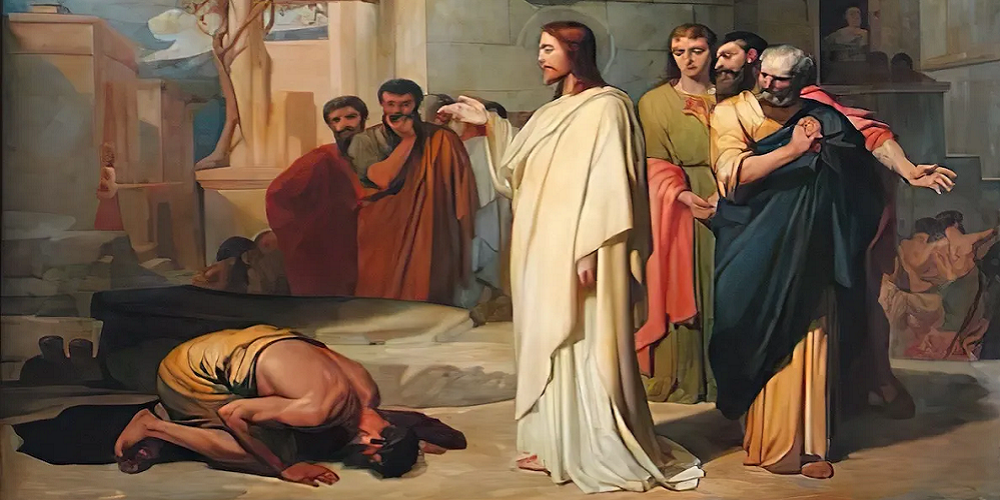
Perhaps because I was born one October 10, I pay attention to that number when it appears anywhere. There are some who say that I am two biscuits short of a dozen, and I don’t quite disagree with them either! The story of the ten lepers cured by Jesus is one of those episodes in Holy Scripture that truly caught my imagination. The terms “leper” and “leprosy” may refer to several diseases in Scripture but let us assume in this case it was one of the most dreaded diseases anyone could catch in those days: something that would render the sick person a social pariah.
On the way to Jerusalem Jesus was going through the region between Samaria and Galilee. As he entered a village, ten lepers approached him. Keeping their distance, they called out, saying, ‘Jesus, Master, have mercy on us!’ When he saw them, he said to them, ‘Go and show yourselves to the priests.’ And as they went, they were made clean. Then one of them, when he saw that he was healed, turned back, praising God with a loud voice. He prostrated himself at Jesus’ feet and thanked him. And he was a Samaritan. Then Jesus asked, ‘Were not ten made clean? But the other nine, where are they? Was none of them found to return and give praise to God except this foreigner?’ Then he said to him, ‘Get up and go on your way; your faith has made you well.’ — (Luke 17:11-19)
I tend to read the Gospel and find parables everywhere, not only when Jesus tells them but also in those instances when He seems to “build them” out of the surrounding circumstances. I think this is one of those occasions.
I noticed that Jesus did not approach the group but He listened to them thus Jesus complied with the Mosaic Law even knowing that the men were instantly cured and were clean from that point on. Yet the instruction was to “go and show yourselves to the priest” so they could be ceremonially cleansed as well and returned to society. That’s an excellent model of a good prayer followed by a good answer and … good thankfulness.
One can understand the nine that hurried to go to the Temple once they realized they were made whole. They were still thinking like “legally unclean” people. Who knows how many years they were leaving in that awful condition! But one out the ten decided to leave the group and approach Jesus to thank Him.
Here is when I noticed the hidden hand of God “organizing” the scene: the grateful man was a despised Samaritan. Think of that! He had leprosy on top of being a Samaritan! That part is not apparent to our contemporary reader. Samaritans were naturally worse than lepers to the Jews of that age. The traditions of that time abound in references to the people of Samaria: “Samaritan women are menstruating from the cradle!” was one of the lightest warnings! Imagine being taught that about a whole race of people whose ancestors were Israelites and even believed in the Law of Moses!
Jesus did not share those extreme views though. He conversed with the Samaritan woman near Jacob’s well (see John 4:1-26, also Matthew 19:16-30, Mark 10:17-31, Luke 18:18-30) and that woman —eventually, not the most virtuous in town— was the first to hear from Christ’s mouth that He was the Messiah! In the parable of the Good Samaritan (Luke 10:25-37) the only good soul who helps the man who “fell into the hands of robbers, who stripped him, beat him, and went away, leaving him half dead” is a Samaritan. Jesus chose the nationality of that man on purpose to show how prejudice can cloud our feelings to the point of making us behave ungodly. I write this knowingly because I have been guilty of that many times. That makes me think that the story of the ten lepers was supernaturally arranged so Jesus could hammer on that point. The Twelve were there watching and learning. There are other famous lepers in Scripture like the Syrian royal officer Naaman in 2 Kings 5 who is cured by the prophet Elisha. In that story, Gehazi —the covetous helper of the prophet— ends up acquiring the leprosy of Naaman. Envious and covetous people should see there a good reason to change for the better.
So, here we have this poor Samaritan returning to Jesus and prostrating himself before his Savior. He is still a Samaritan and most likely he could not have gone to the Levites to confirm his good health so he went —most intelligently but unwittingly— to God Himself!
The number ten is often used in Holy Scripture to represent wholeness. According to Meaning of Numbers in the Bible these are the most commonly quoted passages to illustrate the significance of ten:
The number 10, in the Bible, is used 242 times. The designation “10th” is used 79 times. Ten is also viewed as a complete and perfect numeral, as is 3, 7 and 12. It is made up of 4, which represents the physical creation, and 6, which symbolizes man. As such, the meaning of 10 is one of testimony, law, responsibility and the completeness of order. […] We find, In Genesis 1, the phrase “God said” 10 times, which is a testimony of His creative power. God gave the Ten Commandments to man. Ten therefore represents man’s responsibility to keep the commandments. A tithe is a 10th of our earnings and is a testimony of our faith in the Lord. The Passover lamb was selected on day 10 of the 1st month (Exodus 12:3), as was Jesus, the Lamb that takes away the sins of the world (John 12:28 – 29; 1Corinthians 5:7). Day 10 of the 7th month is also the Holy Day known as the Day of Atonement. This unique day of fasting pictures the removal of Satan, the author of sin (Revelation 20:1 – 2). The last great world-ruling kingdom of man under Satan is symbolized prophetically by the 10 toes of Daniel 2 and the 10 horns of Revelation 13 and 17. (Edited slightly, boldface is mine.)
The quoted notes on the symbolic meaning of the number ten make me think that Jesus organized the event of the lepers to present himself as our Savior, Jesus Hominum Salvator (Latin for “Jesus, Savior of Humankind” also ΙΗΣΟΥΣ ΗΜΕΤΕΡΟΣ ΣΩΤΗΡ, Iēsous Hēmeteros Sōtēr, ‘Jesus our Saviour’ ).
Since we are human, those ten lepers may very well represent all of us. We are all lepers of a kind, infected by sin, exiled from the society of Heaven until Christ comes to our rescue.
Something tells me that those who go around treating others badly (like people treated the Samaritans of that age) will one day regret it. If we are sure of our salvation in Christ, shouldn’t we fall on our knees and thank Him?
There’s something to think about.

 Quod scripsi, scripsi