Years ago I watched a well presented video called The Star of Bethlehem. It was shown a few weeks before Christmas by EWTN. The documentary was the work of Rick Larson. In that video he says “I am a lawyer, I can make a distinction!” I was led to a wealth of knowledge by that phrase. Thank you, Mr. Larson.
The documentary has become very popular among Christians over the past decade. It was produced by Stephen McEveety, who co-produced The Passion of the Christ and has won many awards.
I find no fault at all in the documentary. As a matter of fact I bought several copies of the DVD and I still have one in my library. I watch one or two DVD’s on Sunday evenings and The Star of Bethlehem is one I revisit often. The basic premise of the presentation by Rick Larson, a Protestant, is quite reasonable. He starts with Psalm 19:
The heavens are telling the glory of God;
and the firmament proclaims his handiwork.
Day to day pours forth speech,
and night to night declares knowledge.
There is no speech, nor are there words;
their voice is not heard;
yet their voice goes out through all the earth,
and their words to the end of the world.
From there he builds up a coherent argument using state of the art software to describe the astronomical aspects of the story he presents, centering the star and the birth of Christ in time and space.
A decade ago I posted an article in Spanish to make that material available to Christians in Spanish-speaking countries. It is still read quite often. It was around that time that someone posted a counter-article arguing that the whole reasoning smelled of astrology and superstition. I don’t remember the exact words but his only argument was: “If God wants to turn on a light on top of a manger, He can use a star or anything He wants.” Let’s admit the man was closer to the line of reasoning of the Mohammedans that to Catholic Tradition. But hey! In the words of a now defunct pontiff: “Who am I to judge?” Still, his article was no more than a rant. As far as I know, it never became viral. Mine was!
About that time that poor man was sent to some monastery, punished after abusing his authority as head of a seminary.
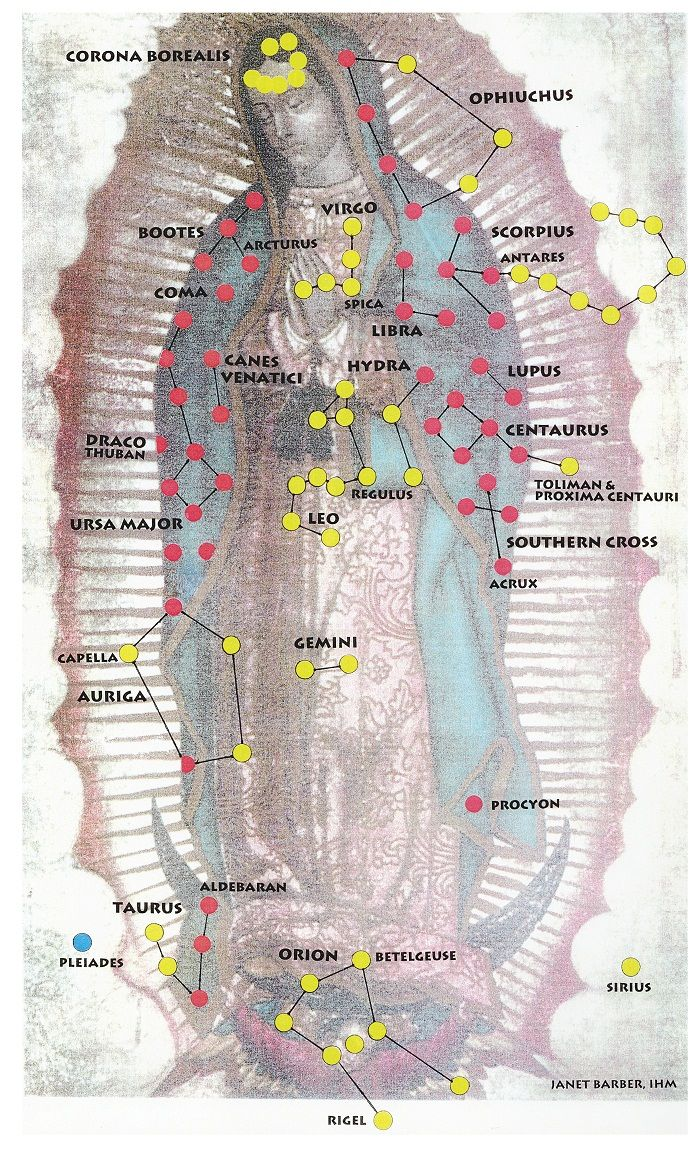
While I was praying today, somehow I remembered that post in Spanish from a decade ago. You can find a post dealing with stars right HERE still dealing with God’s skies “pouring forth speech” as the psalmist says. The new post reported on a recent discovery by Mr. Alessandro Massano, a teacher of astronomy and a loyal Catholic who discovered a correlation between the 46 stars depicted on the mantle of Our Lady of Guadalupe and the number of popes since the original apparitions of Our Lady of Guadalupe in 1531. This is NOT “astrology” or such superstitions as horoscopes, astral charts etc.
There are 46 stars shown on the mantle as I said before. The assignment of those stars to each constellation was known long ago. The astronomer Hernandez Illescas and Fr. Mario Rojas Sanchez have written extensively about it. They are serious people, competent scientists and presumably, good Catholics. Someone even discovered beautiful music written in those stars!
The blue mantle represents the heavens, as if Our Lady was “wrapped” in a mantle of stars. If the tilma was shown fully opened all the constellations would be visible. The folds of her garment hide some of the stars from full view, a few others wrap around her back. Prof. Massano counts the 46 stars that actually appear in the image as they are represented in the mantle. He does not add or substract from those —to the best of my knowledge— Anyone can count the stars in a faithful image of Our Lady of Guadalupe. Many reproductions of the Tilma can be found in the web. I provide one here at the end of this post.
Fifteen of the known eighty-nine constellations appear on her mantle: the ones visible in the night sky over Mexico that night of December 12, 1531. If I remember correctly that has been known since the time of the apparitions. Five other constellations are not depicted in the mantle but would have been displayed outside the mantle in their relative positions. In the image below, the 46 stars in the mantle are indicated by red dots.
The stars are presented to us in a mirror-like image. The Aztecs and Mayas used pools of calm water to observe the night sky in reflection. Wise move on the part of the Mexican first astronomers to avoid neck pain! I guess the stars are shown that way in the Tilma so that the natives could identify them easily.
I was told today that this is “superstition”, that the stars are “cherry-picked” to fit the argument of Mr. Massano. I checked as carefully as I could and I found Massano’s argument to be honest and exact. The heavens continue to declare the glory of God.
If anyone finds any trace of dishonesty or superstition regarding this, please leave me a note using the Contact link in this blog. If you must argue please do it coherently. Simply saying “this is poppycock” is not a coherent argument.
 Quod scripsi, scripsi
BILL
Superstition is one of the favorite accusations of certain secret associations. They think themselves beings of pure reason. But they themselves are not above using defamation and detraction as weapons. There is a bit of a self-centered, dictatorial streak in all that “it is so because I say so” which paradoxically goes against their claim of bringing light to mankind. The argument is weak and certainly ignores the rich tapestry of the Aztec amoxtli painted on the humble Tilma of St. Juan Diego. Amoxtli (book, codex) are complex pictures representing a story or knowledge deemed worthy of being saved and transmitted. By its very nature they are intended to be meaningful. Their meaning is presented to receptors (readers) that share certain conventions with the author. I dare to affirm that nothing in amoxtli is there for no reason of for mere aesthetic reasons. Everything forms part of a layer of meaning. The amoxtli of the Tilma has clear meaning for the eyes of both Aztecs and Spanish. That particular quality makes it even more miraculous!
LikeLike
RECEIVED VIA EMAIL
BILL FROM NEWARK
That definition of superstition could be accepted. However, who says that the author of the picture did not intend the stars to have any meaning? My! Nearly everything in Juan Diego’s tilma is overflowing with meaning! Why should we find meaning in the sun rays, the black ribbon, the people appearing in the eyes of Our Lady and the various other things and symbols shown there EXCEPT the stars, only because Anonymous says so? I don’t quite follow his/her reasoning. The comment’s reasoning is sloppy and not Massano’s.
LikeLike
RECEIVED VIA EMAIL
ANONYMOUS FROM ROME
LikeLike