“I heard but could not understand; so I said, ‘My lord, what shall be the outcome of these things?’ He said, ‘Go your way, Daniel, for the words are to remain secret and sealed until the time of the end. Many shall be purified, cleansed, and refined, but the wicked shall continue to act wickedly. None of the wicked shall understand, but those who are wise shall understand.” (Daniel 12: 9-10)
Not to repeat the concepts exposed in the previous posts please check all the articles related to St. Peter in this blog but specially these two: The cycle of Peter, and Closing the cycle of Peter.
After posting the last article on the Prophecy of the Popes I received a number of suggestions to read material based on that subject. Most of those deal with the interpretation of the colophon quoted above: “in persecutione extrema, etc.” and most try to understand that prediction by applying the name of Peter to several contemporary men that could eventually be papabile, that is to say likely to be elected in a papal election conclave.
Considering that this prophecy is at best a document that has been tampered with, we are forced to take it with much caution and discernment. Personally, I am intrigued by certain things I found in the text. We will read the last part of the document now, beginning with the only person named in it: Petrus Romanus, Peter the Roman.
Who is Peter the Roman? Well, we are given a few clues. In the previous post Prophecy of the Popes we saw how the whole list seems to define a certain age of the Papacy. I call that the Petrine Age. That period starts on the shores of Lake Gennesaret where Jesus selects Simon Peter to lead the Church that is destined to be the New Israel thus fulfilling the mission that natural Israel did reject.
Why the rejection? That is a huge mystery. The Jews of the time of Jesus were convinced that the Messiah was about to appear in their time. They imagined their Messiah as a powerful warrior who was going to conquer the entire world. That age saw first the emergence of Alexander the Great whose dominion extended rapidly all over the known world. After the demise of Alexander, the world was divided among four of his generals. Greek culture expanded to the whole Mediterranean and then, after a series of wars, Rome began its ascendance to world domination. You know all that. What concerns me now is to see the Greco-Roman world as a backdrop for the life of Simon the Fisherman, the man whom Jesus chose to begin the conquest of the world.
The shores of Gennesaret
Little did the inhabitants of Bethsaida imagine that a boy born amongst them was going to conquer Rome one day. One of the many names of that city was “the unconquerable city” —God seems to enjoy testing the pride of men— and like the “unsinkable Titanic” the mettle of Rome was going to meet a rock —not made of ice mind you but something harder— visible only with the eyes of the spirit.
The actors in this drama are: the Jews, the remnant of ancient Israel, plus Simon Peter, and the mighty Roman Empire.
The Pharisees and Sadducees came, and to test Jesus they asked him to show them a sign from heaven. He answered them, ‘When it is evening, you say, “It will be fair weather, for the sky is red.” And in the morning, “It will be stormy today, for the sky is red and threatening.” You know how to interpret the appearance of the sky, but you cannot interpret the signs of the times. An evil and adulterous generation asks for a sign, but no sign will be given to it except the sign of Jonah.’ Then he left them and went away. (Matthew 16:1-4)
Simon Peter was there when Jesus admonished those who demanded a sign, a demonstration of messianic power. The response of Jesus is cryptic but we can understand it now: “You do not know the signs of the times” that is —in good street English— “you are jumping the gun!” Those men were itching to start the military conquest of the world by Israel. Jesus would have none of that. He had other plans.
Standing there with the other disciples was Simon Peter. We know his ideas were not very different from those of his contemporaries. We get to know him in the Gospels as a man who was trying to be a good Jew but also a man who was very conscious of his shortcomings. He had met Jesus a short while before not far from that very spot.
Once while Jesus was standing beside the lake of Gennesaret, and the crowd was pressing in on him to hear the word of God, he saw two boats there at the shore of the lake; the fishermen had gone out of them and were washing their nets. He got into one of the boats, the one belonging to Simon, and asked him to put out a little way from the shore. Then he sat down and taught the crowds from the boat. When he had finished speaking, he said to Simon, ‘Put out into the deep water and let down your nets for a catch.’ Simon answered, ‘Master, we have worked all night long but have caught nothing. Yet if you say so, I will let down the nets.’ When they had done this, they caught so many fish that their nets were beginning to break. So they signaled to their partners in the other boat to come and help them. And they came and filled both boats, so that they began to sink. But when Simon Peter saw it, he fell down at Jesus’ knees, saying, ‘Go away from me, Lord, for I am a sinful man!’ (Luke 5:1-8)
In the first story of the miraculous catch of fish Jesus appears right after Peter has failed. (cf. John 15:5) After working all night for naught, his crew had not one fish to take to the market. Total failure. Watch the image on this passage because we may be seeing a model, a prophetic representation of our own age. When Jesus takes over the failing enterprise lo and behold! The boats are filled to capacity and miraculously fail to sink under the enormous weight of the catch! I am convinced that this is a visual parable of the triumph of the Church in the end times.
There Peter acknowledges two things: his own sinful nature and Christ’s divinity. Peter instinctively knows he is witnessing a miracle that can only come from God. From that very moment Christ keeps Peter in pectore to be the man who will receive the keys of the Kingdom. Peter is reserved for bigger things but first he has to be trained and transformed. We see the entire transformation in Scripture.

Peter the Jew is transformed
In Matthew 16 we have an inkling of what is inside Peter’s mind when he rebukes Jesus: “God forbid it, Lord! This must never happen to you.” (v.22) The Cross does not even enter into Peter’s thoughts. He is thinking about the establishment of the universal Israel in a way similar to the Pharisees. In his mind, Jesus was the man who was going to lead the armies of Israel to conquer the world by military means. That was the standard thinking among Jews of that age. Of course, Peter was right about Jesus conquering the world but Peter (along with everyone else) was wrong about the time and the way the conquest was going to be effected. He begins to get the idea of God’s plan for the world years later when he is sent to Cornelius, the Roman centurion. (cf. Acts 10) In vv. 34-36 notice how he begins to see the light:
“Then Peter began to speak to them: ‘I truly understand that God shows no partiality, but in every nation anyone who fears him and does what is right is acceptable to him. You know the message he sent to the people of Israel, preaching peace by Jesus Christ—he is Lord of all.“
It will take Peter the Jew a long time to realize how the plans of God are much superior to the brute force schemes he entertained in his mind. Perhaps in Peter we have a model of natural Israel, and how long it will take for them to wake up to the fact of Christ’s lordship over the nations. The universality of the mission God had for Israel was evident since the times of Joseph, betrayed by his brothers and sold as a slave to end up as a ruler of Egypt. (cf. Genesis 35-40) That ancient nation is used in Scripture often to symbolyze the world.
The preoccupation with the immediate establishment of the Kingdom never abandons the mind of the disciples even after the Cross. While gathered around the Resurrected Jesus they ask about it. Jesus patiently explains the universal mission all over again:
Then they gathered around him and asked him, “Lord, are you at this time going to restore the kingdom to Israel?” He said to them: “It is not for you to know the times or dates the Father has set by his own authority. But you will receive power when the Holy Spirit comes on you; and you will be my witnesses in Jerusalem, and in all Judea and Samaria, and to the ends of the earth.” (Acts 1:6-8)
Peter is gradually taught by experience about the catholicity of Christ’s mission. We often understand the term ‘Catholic’ geographically as universal but it is much more than that. The universality of Christ’s mission reaches the very limits of time, geography, ethnicity, and then much more. He is Creator and Redeemer of the Universe in ways that we can only fathom now. We can laugh at Peter’s simplicity or at the thick-headedness of the Pharisees and Sadducees but we are not really much wiser than they were! We follow Christ like Peter, having a foggy idea of where we are going but still walking confidently after Him. That is the essence of the Catholic faith, that is catholicity: the flock will follow the Shepherd to the stars if needed. (cf. Genesis 15:5-6)
In time, Peter is resisted by St. Paul on the matter of the Judaizers. We see (as St. Paul did) that our first Pope was falling back into that vision of the natural Israel as an exclusive Jewish enclave. That lack of constancy to hold on to God’s teachings was not really sinful but human. Peter was returning to the safety of his youth in Bethsaida and Capernaum, to his fishing days. He always does that! (cf. John 21:3) But every time God brings him back to his true mission. Towards the end of his life he is shown again the road ahead of him, Peter runs from the Cross but he humbly accepts it in the end.
“In this story, Peter is fleeing Rome, where persecution is rampant. As he walks down the road that leads out of Rome, he encounters Christ… walking on the same road, but towards Rome. Surprised by this encounter, Peter asks Jesus, “Quo Vadis?” Wearily, Jesus looks at Peter and tells him, “I am going to Rome to be crucified again.” As the story goes, this encounter led Peter to turn around and go back to Rome where he was indeed crucified.” (See “Quo Vadis?” St. Peter’s Call to Martyrdom in Rome by Michele Chronister)
You may be wondering …
You may be wondering where is this post going. Patience! I promise you we are about to reach the final dot.
The theme of this post is that mysterious Petrus Romanus in the no less mysterious Prophecy of the Popes.
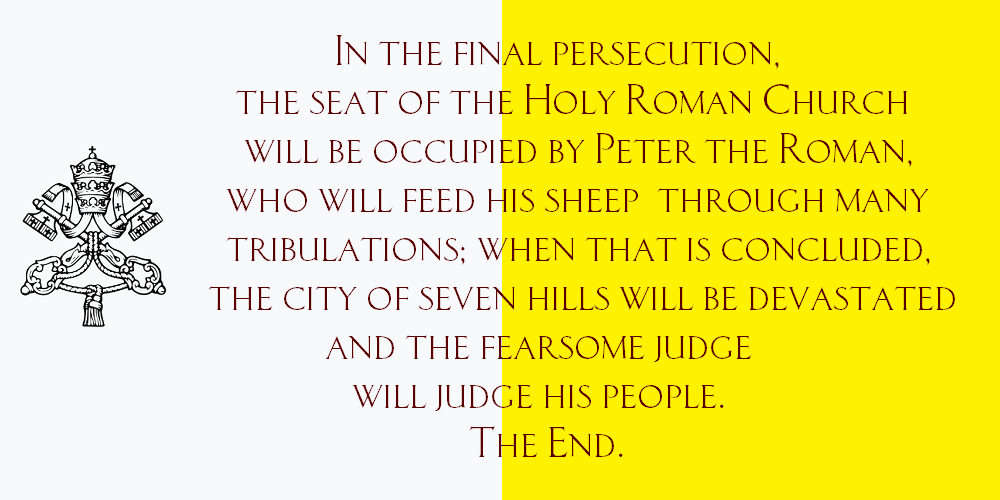
In the final persecution, the seat of the Holy Roman Church will be occupied by Peter the Roman, who will feed his sheep through many tribulations; when that is concluded, the city of seven hills will be devastated, and the fearsome judge will judge his people. The End.
Just like you, I have no idea who Petrus Romanus is. All I know is what is contained in the lines quoted above. He shall sit (sedebit) on the throne of Peter in Rome. Why instead of “sit” the author would not use the verb “reign”? Is this going to be a bad pope? Is the papacy going to experience exile?
A pope feeding the flock is a good Pope and Petrus Romanus “will feed his sheep through many tribulations” —Simon Peter was rebuked by Jesus when “he turned and said to Peter, ‘Get behind me, Satan! You are making me stumble; for your thoughts are not God’s thoughts human thoughts.’” (Matthew 16:23) and that makes me think of the many times when Popes embraced the world and forgot their mission. The way the phrases are built there is a sharp contrast between v.17 “flesh and blood has not revealed this to you, but my Father in heaven” and v.23 “your thoughts are not God’s thoughts”. In the first, Peter thinks like God while in the second his thoughts are resisting God. Sometimes I think of that arc between v. 17 and v. 23 as Jesus’ way of warning us that the Papacy (Peter’s mission) will be affected by decay and the attacks of the enemy until its very mission is compromised. Petrus Romanus feeds the flock in spite of persecution, tribulation. He does not seem to run from the Cross. The transformation is now complete.
This Petrus is the last Peter whom will most likely receive the Jews into the Church thus completing the flock. When Peter the Jew becomes Peter the Roman, Rome and Israel are finally united to meet Christ and go on to truly transform the entire world. As usual, the price for conquering the world must be paid with one’s soul. I sense Petrus Romanus is going to be martyred just like Peter the Jew.
‘I am the good shepherd. The good shepherd lays down his life for the sheep. The hired hand, who is not the shepherd and does not own the sheep, sees the wolf coming and leaves the sheep and runs away—and the wolf snatches them and scatters them. The hired hand runs away because a hired hand does not care for the sheep. I am the good shepherd. I know my own and my own know me, just as the Father knows me and I know the Father. And I lay down my life for the sheep. I have other sheep that do not belong to this fold. I must bring them also, and they will listen to my voice. So there will be one flock, one shepherd. (John 10:11-16)


 Quod scripsi, scripsi