I find myself thinking about Matthew 16 over and over. It is a habit that I can’t quite shake but I do not think it is a bad habit. That theme filled my thoughts this morning when a friend came to visit. This friend of mine is a Protestant, a member of one of those vague denominations so common in these parts. My friend had some questions about the current events and soon our conversation was drawn to the common ground of Scripture.
They asked for a sign
The Pharisees and Sadducees came, and to test Jesus they asked him to show them a sign from heaven. He answered them, ‘When it is evening, you say, “It will be fair weather, for the sky is red.” And in the morning, “It will be stormy today, for the sky is red and threatening.” You know how to interpret the appearance of the sky, but you cannot interpret the signs of the times. An evil and adulterous generation asks for a sign, but no sign will be given to it except the sign of Jonah.’ Then he left them and went away. (Matthew 16:1-4)
The Pharisees and Sadducees asked for a sign and Jesus gave them one. This time it was neither some mysterious drawing on wet sand nor a miracle or a story. The sign went right over the heads of Jesus’ opponents. They were as blind to it as I was this morning twenty centuries later. Today I saw it for the first time. I must converse more often with friendly Protestants; they seem to have a stimulating effect on my perception of Scripture. “Iron sharpens iron, and one man sharpens the wits of another.” (Proverbs 27:17)
When reading or praying Scripture I find most useful to take in the “image” presented to us. There are many ways one can use to imagine the scene, or the thoughts to be considered. Today, totally out of the blue, the idea came to me to create this device: a bird that would observe the landscape of that day by the shores of Lake Gennesaret. Later I imagined this bird flying so high that it was able to look at both shores. Additionally, that imaginary bird could look at history from an equally high vantage point in time. I had space and time sewn together in some Einsteinian way helping me understand that Jesus created a sign on the fly. May be others have seen this before but for me it was a first.
The sign is a prophetic bird’s eye view of the history of Israel. It begins with the old Israel, the nation that is quickly arriving at the end of its mission after having produced their Messiah. Then there’s that present with Christ standing on the beach. On one side He has the Pharisees and Sadducees representing the past of Israel. On the other side and already boarding Peter’s barque there are the Twelve. They are the future, the New Israel, the Church in its embryonic form about to embark in the final mission: the conquering of the world by the Messiah. The conquest is not going to involve military forces but humble spiritual weapons and myriads upon myriads of angels invisible to almost everyone but God. The mission of the New Israel is universal: “for my house shall be called a house of prayer for all nations.” (Isaiah 56:7)
Jesus and his Twelve are going to cross the Gennesaret. That is a figure of the Church crossing the expanse of history. They board the boat and leave the coast near Capernaum in the general direction of the Decapolis, the ten cities where Greeks, Romans, Syrians and other pagans reside. The other coast represents the objective of the New Israel: to preach the Gospel to every nation on earth. Please hold this image in your mind while we read the whole sign. In an astonishing display of His Divinity, Christ is going to instantly deliver that sign He was asked for. In the meanwhile his enemies see nothing, blinded as they are by envy and hate.
The sign of Jonah
Jesus explains: “An evil and adulterous generation asks for a sign, but no sign will be given to it except the sign of Jonah.” What is this “sign of Jonah”? It seems to me that Jesus wants us to think hard about this mysterious sign. I see one particular characteristic in the prophet Jonah that we can find also in Saint Peter: reluctance. Jonah hears the voice of God commanding him to go to Assyria in an apparent suicide mission: to warn that nation of their impending destruction by divine decree. We know the story: Jonah runs away from his mission but a series of events cause him to end up in the belly of a big fish. Finally Jonah decides to accept his mission and the nation is saved. In that I see a premonitory model of Peter and the Church.
Peter was a Jew who believed (like almost any other Jew of his time) that the Messiah was going to “make Israel great again” through military and political actions. However, God had other plans. Throughout his life, Peter failed to understand what God was doing (just like the Pharisees and Sadducees by the lake) and in the end he tries to escape from his mission. In the conversion of Cornelius, God tells Peter in a vision His intention to save the gentiles. That causes Peter to admit: “Can anyone withhold the water for baptizing these people [Cornelius household] who have received the Holy Spirit just as we have?” And so, Peter’s strong prejudice against Greeks and Romans was miraculously dispelled.
Evangelization is one thing, sacrifice and salvation are different. Late in his life, Peter is sent to the city of Rome. When the emperor begins to persecute the Christians there, Peter tries to run away in the same manner that Jonah did before.
In this story, Peter is fleeing Rome, where persecution is rampant. As he walks down the road that leads out of Rome, he encounters Christ…walking on the same road, but towards Rome. Surprised by this encounter, Peter asks Jesus, “Quo Vadis?” Wearily, Jesus looks at Peter and tells him, “I am going to Rome to be crucified again.” As the story goes, this encounter led Peter to turn around and go back to Rome where he was indeed crucified. (See “Quo Vadis?” St. Peter’s Call to Martyrdom in Rome by Michele Chronister)
Peter repeats the lesson of Jonah: we are here to execute a divine mission. God is the planner, we are not. A few days after his encounter with the Crucified, Peter offers his life in the Roman Circus Maximus. His glorious martyrdom transforms him in St. Peter paving the way to the conquest of Rome by Christianity. The reluctance of Jonah is a prefiguration of Peter’s unwillingness. The lesson is clear: God is going to save us in spite of our thick heads and fearful hearts. God is teaching us to trust Him. He is going to save the world His way. His plans are way above anyone’s capacity to understand.
Back to Gennesaret
The puzzled Pharisees and Sadducees are left on the beach and “the sign” begins to develop. At the heart of Christ’s work is the salvation of Israel. The vocation of Israel as a chosen nation was to grow until the Messiah arrives and reveals the universal mission God has for them. But not all of Israel accepts. Some hold on to the idea of conquering the world through military might. That is why the Church, composed by Jews and Gentiles, had to accept the challenge. That is the meaning of “Then [Jesus] left them and went away.” (Matthew 16: 4) Israel is frozen in time, Jesus is moving on to greater things. Israel can’t imagine what is coming. They see when the weather is changing but they can’t see what lies ahead for them in history.
The Yeast of the Pharisees and Sadducees
When the disciples reached the other side, they had forgotten to bring any bread. Jesus said to them, ‘Watch out, and beware of the yeast of the Pharisees and Sadducees.’ They said to one another, ‘It is because we have brought no bread.’ And becoming aware of it, Jesus said, ‘You of little faith, why are you talking about having no bread? Do you still not perceive? Do you not remember the five loaves for the five thousand, and how many baskets you gathered? Or the seven loaves for the four thousand, and how many baskets you gathered? How could you fail to perceive that I was not speaking about bread? Beware of the yeast of the Pharisees and Sadducees!’ Then they understood that he had not told them to beware of the yeast of bread, but of the teaching of the Pharisees and Sadducees. (Matthew 16:5-12)
How easy it is for us to smile at the simplicity of the Twelve! But they are simply playing a part for our education. Let us respectfully read and learn. They forget to bring bread and Jesus is now talking about yeast. We must one more time look at the image. Jesus is the only bread the Twelve have in the boat but they will awake to the idea of Jesus-as-bread much later. It took me a lifetime to see it there!
With infinite patience, Jesus explains to the Twelve about the doctrine of the Pharisees and Sadducees. The doctrine is flawed. They think the Messiah is coming to redeem Israel as a conqueror, a great general. That is not consistent with God’s will. See how that is clearly shown in Acts 1:6-8.
Then they gathered around him and asked him, “Lord, are you at this time going to restore the kingdom to Israel?” He said to them: “It is not for you to know the times or dates the Father has set by his own authority. But you will receive power when the Holy Spirit comes on you; and you will be my witnesses in Jerusalem, and in all Judea and Samaria, and to the ends of the earth.” (Acts 1:6-8)
In the passage of the Acts of the Apostles quoted above, the resurrected Jesus explains to the disciples the progression that will lead to the conquest of the world through witnessing the faith: first Jerusalem, then Judea, then Samaria and finally those who are in darkness: the nations outside, all of them no matter how far. We are in that lot. Christ clearly stated that intention once: “I have come to bring fire on the earth, and how I wish it were already kindled!” (Luke 12:49) The fire of Jesus’ message is the doctrine that Sadducees and Pharisees don’t understand. Like Jonah, they are reluctant to follow Jesus. Instead they want Jesus to follow them and their ideas of military and political conquest. Such is the yeast that inflames men’s hearts the wrong way with dreams of conquest and worldly glory. That —like yeast— grows moldy and eventually spoils the bread. Jesus, the Bread from Heaven is not like that. He will conquer the world through the Cross in humility and meekness because His kingdom will not rot, it will last forever.
“When the disciples reached the other side, they had forgotten to bring any bread.” (Matthew 16:5) In the sign Jesus is constructing here “the other side” is the maturity of the Church in history. We shall see later how the successors of St. Peter will gradually lose the grasp of their mission, forgetting the basic vocation that led them there. The preoccupation with the things of this age will cause them to grow too close to the halls of worldly power. Pride and haughtiness will invade many hearts while the Church of the latter days allies with the wayward nations in the same manner that Pharisees and Sadducees allied with Roman authorities to eliminate Jesus.
Peter’s Declaration about Jesus
Now when Jesus came into the district of Caesarea Philippi, he asked his disciples, ‘Who do people say that the Son of Man is?’ And they said, ‘Some say John the Baptist, but others Elijah, and still others Jeremiah or one of the prophets.’ He said to them, ‘But who do you say that I am?’ Simon Peter answered, ‘You are the Messiah, the Son of the living God.’ And Jesus answered him, ‘Blessed are you, Simon son of Jonah! For flesh and blood has not revealed this to you, but my Father in heaven. And I tell you, you are Peter, and on this rock I will build my church, and the gates of Hades will not prevail against it. I will give you the keys of the kingdom of heaven, and whatever you bind on earth will be bound in heaven, and whatever you loose on earth will be loosed in heaven.’ Then he sternly ordered the disciples not to tell anyone that he was the Messiah. (Matthew 16:13-20)
The time has come to reveal who Jesus really is and what mission He will assign to the disciples. Peter receives the keys of the Kingdom of the Heavens. He is in charge of the Royal House of Israel without unsheathing his sword. The concept was “downloaded” into Peter’s mind because he is still unable to comprehend what he has gotten himself into. In a way, he is still thinking like the Pharisees and Sadducees with one difference: he loves Jesus and will follow Him to the ends of the earth. That becomes clear when Peter is rebuked by Jesus …
Peter rebuked by Jesus
From that time on, Jesus began to show his disciples that he must go to Jerusalem and undergo great suffering at the hands of the elders and chief priests and scribes, and be killed, and on the third day be raised. And Peter took him aside and began to rebuke him, saying, ‘God forbid it, Lord! This must never happen to you.’ But he turned and said to Peter, ‘Get behind me, Satan! You are a stumbling-block to me; for you are setting your mind not on divine things but on human things.’ (Matthew 16:21-23)
Jesus finally brings up the matter of the Cross. It is a completely counterintuitive concept: to sacrifice one’s life to conquer the world. Only God can do that. Even if a man gives up his life the sacrifice is final. It is not possible for an ordinary man to resurrect. Jesus is not an ordinary man, He can defeat death and in so doing he can defeat sin. Once that is accomplished He can come back to the world and truly conquer it —not to please the Pharisees and Sadducees but to claim what is His by sovereign right— But poor Peter can only see suffering as a loss. He does not want that for Jesus and he intervenes saying ‘God forbid it, Lord! This must never happen to you.’ The man who could hear God’s plans and identify the Messiah (Matthew 16:16) draws dangerously close to resisting the Holy Spirit. How is that possible?
Again, we have to look at the image. In the rich tapestry of Matthew 16 we see how Christ builds an extraordinary parable that only God could imagine. It is the response to those asking for a sign. The barque of Peter has crossed the sea of history from the Judean side of the sea (where the Jews are with their Law and the Temple of God) to the other side where the Gentiles are: to those Gentiles the Church, the New Israel, will declare the Good News because the Jews have decided not to follow Jesus to fulfill the universal destiny of Israel. Peter represents the history of the papacy within that image. The first Pope struggles to follow Christ but he is assailed by his many imperfections. The value of his loyalty to Christ makes up for all his other shortcomings. He is hearing God and he gives the perfect testimony of Jesus at first. After that, in a strange but beautiful symmetry, Peter utters a satanic message so similar to what Jesus heard when he was tempted in the wilderness: “be kind to yourself, turn those stones into bread, etc.” In doing that, Peter prefigures alter Petros that will come at the end of times, a man that will not want to be owned by Christ, a man incapable of true self-denial. In saying ‘this must never happen to you’ our first Pope channels the last Pope, the Pope of the apostasy mentioned by St. Paul in 2 Thessalonians 2:3. Jesus now proceeds to close this part of the parable he started building when he was talking to the Pharisees and Sadducees standing on the opposite shore. He introduces the Sign, the “nuclear option” as we would say today: the power of self-denial, the power of the Cross.
In Hoc Signo Vinces — The key to true power and conquest: the Cross
Then Jesus told his disciples, ‘If any want to become my followers, let them deny themselves and take up their cross and follow me. For those who want to save their life will lose it, and those who lose their life for my sake will find it. For what will it profit them if they gain the whole world but forfeit their life? Or what will they give in return for their life? ‘For the Son of Man is to come with his angels in the glory of his Father, and then he will repay everyone for what has been done. Truly I tell you, there are some standing here who will not taste death before they see the Son of Man coming in his kingdom.’ (Matthew 16:24-28)
Can anyone be more clear than that? The price of conquering the world is ONE SOUL but it has to be a Divine Soul able to return from death to claim the prize. The Cross is the instrument that will decide the war between good and evil. That is the ultimate divine weapon.
The parable closes and our poor Peter is left there scratching his head and wondering how he could be called a friend of God the Father and only minutes later be downgraded to satan? He will be and instrumental part of the Sign of Jonah, a new Jonah of sorts, similar to the first for his fear and reluctance and also for his final resolve to face and achieve the end of his mission.
Conclusion
In my opinion, we are living at a time in history represented by the end of the Sign. Perhaps (it is something that must be carefully discerned) this Sign is the sign that Our Lady refers to when she told us “The only arms which will remain for you will be the Rosary and The Sign left by My Son.” (Quoted from the Message to Sister Agnes Sasagawa at Akita) The Sign given to the Pharisees and Sadducees is the Cross as the instrument by means of which Christ will redeem Israel. We are told that “He is coming with the clouds, and every eye will see him, even those who pierced him; and all peoples on earth will mourn in lament because of him.” (Revelation 1:7) Cross and Resurrection are proof of the divinity of Christ and His right to rule Israel forever. The prophet Jonah (Hebrew: dove) emerged from the sea after three days, Christ emerged from the tomb on Sunday and changed the world forever. They asked for a sign and they got it along with two thousand years to reflect upon it.
According to the “controversial” Prophecy of the Popes by St. Malachi of Armagh, Benedict XVI was the last Pope of this age (De Gloria Olivae) symbolized by the olive, the plant used often to represent resurrection. In that prophecy, the last pope of the list is followed by a certain “Peter the Roman” (Petrus Romanus) who is there as if he was an additional pope off the list, so to speak.
Additionally, Conchita Gonzalez, the visionary of Garabandal reported a locution that announced the number of Popes until the End Times. Those would be Paul VI, John Paul II, and Benedict XVI with a mention of John Paul I as “one Pope that will reign only a short time.” That would put us right at the edge of the End Times and also during that time when the apostasy would be manifest.
This seems to be the time (when Peter unwittingly resisted the Cross) at the end of that cycle represented in Matthew 16. (cf. verse 16) That act of Peter was an image, a prophetic representation of one (or many) successors to the Petrine chair that would preside over the general apostasy before the End.
The order of events seem very clear to me at this time but much prudent discernment must follow. If these thoughts are mostly correct, we seem to be about to enter the last persecution, the time when the Church flees to the wilderness to be fed for 42 months. “The woman fled into the wilderness to a place prepared for her by God, where she might be taken care of for 1,260 days.” (Revelation 12)
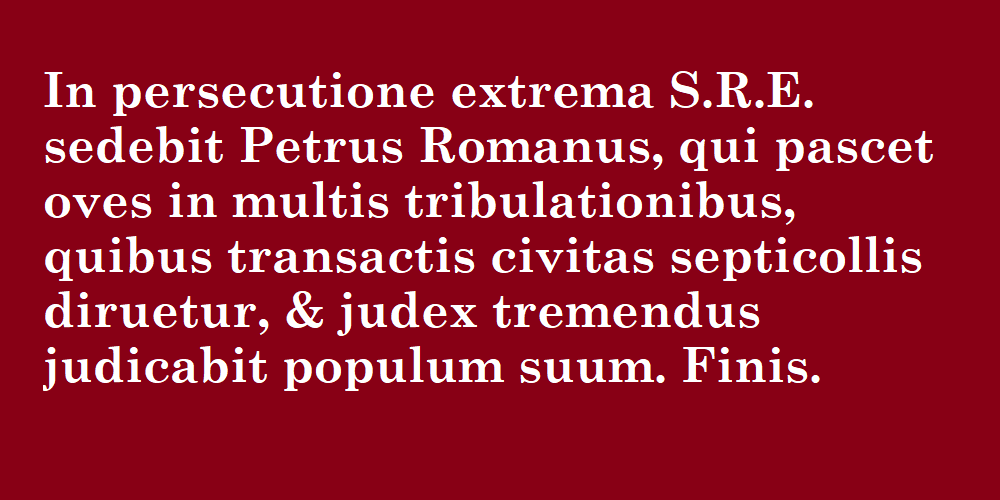
“In the last persecution of the Holy Roman Church, there will sit Peter the Roman, who will pasture his sheep in many tribulations, and when these things have happened, the seven-hilled city will be destroyed, and the terrible judge will judge his people. The End.” (Colophon of St. Malachi’s Prophecy of the Popes)
At this time we will finally confirm the prophecies of Garabandal and St. Malachi. All is coming to a head.
As time advances we shall see the great prophesied events develop. It is time to pray for our brethren all over the world as the hour of trial approaches. Please, pray for me as well as our redemption nears.
From the west, people will fear the Name of the LORD,
and from the rising of the sun, they will revere His glory.
For He will come like a pent-up flood
that the breath of the LORD drives along.
(Isaiah 59: 19)

 Quod scripsi, scripsi
https://gloria.tv/share/6FBGeoGFokrTCUNC7KJ7URxoD
LikeLike
RECEIVED VIA EMAIL
FROM VETUS ORDO
Benedict XVI was the glory of the olive tree. Olive trees are grown in farms and gardens such as Gethsemane. In the wilderness, all kinds of things grow: thorns, thistles, poison ivy, all kinds of bad and also some good plants. If Benedict was a good tree his false successor was poison ivy, growing everywhere, choking and sickening every living thing. So … We should say that Popes feed the flock with the bread of life but impostors feed sinners with something that can only harm them even more than sin.
That gives a whole new meaning to the English expression “mercy killing”. With that in mind, now go and read John 10:1-6
We are in the wilderness now for 42 months (Revelation 12)
LikeLike
RECEIVED VIA EMAIL
FROM ANONI MOUSSE 🙏
Excellent as always. And of course, it inspired hundreds of thoughts – four or five of which I managed to retain. At the end of their age – the age of the second temple, the Pharisees had given themselves over to worldly (i.e. political) concerns. They imagined the Messiah through that narrow aperture – and while peeping through they managed to miss the rest of the scene.
Some today speak of the horizontal axis (the world) and the vertical axis (spiritual realm). The late pope seemed to favor the horizontal over the vertical and seemed to do so repetitively without providing a spiritual context. It’s one thing to offer physical comforts to the poor, part of the good works we are called to provide, and quite another to affirm them in their ignorance by (among other missteps) opining that all paths lead to God. I believe he said “all religions”, but I have come to see that “progress” is a religion offered by modern Pharisees who see only the horizontal and believe that salvation is found in the enforcement of the moral narrative of progressive liberalism.
Progressives make metaphysical claims about the nature and purpose of life, the telos of human life, the nature of sin, the means for salvation, and so on that cannot be evaluated empirically – thus their claims constitute religious convictions about our purpose, meaning and spiritual disposition. So their worldview has all of the features of a dogmatic religion with the notable exception of revelation. Rather it is an exercise in wishful thinking and rationalization. It is a mystery cult that denies mystery and relies instead on human rationality. The only revelation allowed is data derived from “objective” observation. Science reveals. But only the interplay of objects may be observed. The interplay of spirits is disallowed by definition.
So how that particular religion leads to God is impossible for me to imagine. However the Pharisees saw themselves as protectors of the cult. They were ruthless in protecting their worldview to the point of torture and murder of anyone with a different idea. Not only Jesus, but all of the apostles save John were martyred. The Pharisees missed the point of the entire Old Testament or Talmud. They couldn’t see the signs, nor the meaning of Scripture because they had invested their souls in worldly concerns. And here we are again. There are Pharisees in positions of temporal power in the Church who miss the point of both the Old and the New Testaments. They downplay the vertical (spiritual) and accent the horizontal. They see salvation in the light of progressive evolution of society and seem blind to the effects of sin in others and in themselves. What is proposed is hubris. There is very little humility on display and revelation has been adulterated by being “rationalized”.
Nebuchadnezzar dreamed of a statue made from a descending value of material from the gold head to clay and iron feet. Daniel interpreted for him the meaning as it was revealed to Daniel by God. The descending value of material represented the kingdoms to come, each one stronger but more vulgar and less spiritual than the previous. A rather anti-progressive image! In the time to come, a stone cut by no hand (the same stone rejected by the builders that became the cornerstone) smashes the statue into pieces. It is Christianity. The stone is Christ. The last kingdom is Rome – the strongest and the most vulgar (earthly) of all the ancient kingdoms.
And we in the west are mirroring that descent into vulgarity. Our Pharisees chatter on about climate change and the overthrow of societal norms in the name of an impossible equity. Their vision is stuck on the wrong side of the lake. They look to technological strength to save them from worldly aggression and vicissitudes. We know how that turned out for the Second Temple. I doubt we will fare any better. Our feet are of clay mixed with silicon. It is even more brittle than iron and clay. The stone not cut by hands is Christ. In the prophetic vision(s) of Revelation, the stone (now a flaming mountain) comes down from heaven. Watch where you step!
LikeLike