“The current hierarchy accents the secular and gives it pride of place over the spiritual. I read whatever I can get on the center right side of the Catholic commentariat. Many of them have been fooled by plucking forth scriptural pieties and exhortations, but their fundamentals appear to be irreligious. Their focus is worldly and political. This seems to be the ancient priestly failure of the Bible; an historically recurring cycle. But what do we do? Stop going to Mass? Wait for God to light a lamp? Become protestants and go Sola Scriptura? What to do? I really don’t know and I am increasingly anxious.” (Anonymous) — Received via email and edited slightly to fit the purposes of this article.
* * *
“C. S. Lewis’s path to Christian faith was helped along mightily by certain authors. In his autobiography, Surprised by Joy, he tells of his discovery of G. K. Chesterton’s writings and says specifically, “I read Chesterton’s Everlasting Man and for the first time saw the whole Christian outline of history set out in a form that seemed to me to make sense. You will remember that I already thought Chesterton the most sensible man alive ‘apart from his Christianity.’ Now, I veritably believe, I thought—I didn’t of course say; words would have revealed the nonsense—that Christianity itself was very sensible ‘apart from its Christianity.’” […] The value that Chesterton brought in that book was the “outline of history” from which Lewis could see for the first time how a Christian worldview could make a coherent statement about the development of history, how one could view all of history through the Christian lens.” — Quoted from The Christian Lens, by Dr. K. Alan Snyder.
* * *
“In the beginning was Logos [Λόγος], and Logos was with God, and Logos was God. He was in the beginning with God; all things were made through him, and without him not anything made that was made. In him was life, and the life was the light of men. The light shines in the darkness, and the darkness has not overcome it.” — (John 1:1-3)
* * *
“In speaking of this desire for our own far off country, which we find in ourselves even now, I feel a certain shyness. I am almost committing an indecency. I am trying to rip open the inconsolable secret in each one of you—the secret which hurts so much that you take your revenge on it by calling it names like Nostalgia and Romanticism and Adolescence; the secret also which pierces with such sweetness that when, in very intimate conversation, the mention of it becomes imminent, we grow awkward and affect to laugh at ourselves; the secret we cannot hide and cannot tell, though we desire to do both. We cannot tell it because it is a desire for something that has never actually appeared in our experience. We cannot hide it because our experience is constantly suggesting it, and we betray ourselves like lovers at the mention of a name. Our commonest expedient is to call it beauty and behave as if that had settled the matter. Wordsworth’s expedient was to identify it with certain moments in his own past. But all this is a cheat. If Wordsworth had gone back to those moments in the past, he would not have found the thing itself, but only the reminder of it; what he remembered would turn out to be itself a remembering. The books or the music in which we thought the beauty was located will betray us if we trust to them; it was not in them, it only came through them, and what came through them was longing. These things—the beauty, the memory of our own past—are good images of what we really desire; but if they are mistaken for the thing itself they turn into dumb idols, breaking the hearts of their worshipers. For they are not the thing itself; they are only the scent of a flower we have not found, the echo of a tune we have not heard, news from a country we have never yet visited.” ― Quoted from The Weight of Glory by C.S. Lewis.
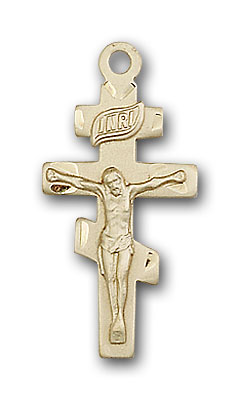
The figure of Peter in Matthew 16 is meant to be the imperfect reflection of Christ. That is why Peter was crucified upside down (his own request, according to Tradition) so we could consider Peter’s cross a mirror image of the Crucified in Heaven.
Besides the mission of Peter we have to consider the development of his destiny because he presides above the flock as one of us, as alter Christus. The idea is there, artfully concealed in Matthew 16. Peter goes from being the man in whose ears God whispers the ineffable law to a man whom Christ compares to the resister, ordering him sternly “stand behind me, Satan!”
At the beginning of the hidden parable that is centered on Peter, Jesus finds him mending the fishing nets “tying and untying” the knots that will contain the catch. Peter’s trade is the divine training determined by God to prepare him to “catch men alive” — Jesus did build living allegories many times during his brief walk among us. He also built a parable with Peter at the center, a representation of something that transcends the mere literal description of the Fisherman as a leader of the Apostles.
When we get to the events described in Matthew 16 the parable is crowned by a brief but powerful representation of what the life of Peter is going to lead to. Peter starts in a saintly manner, his message unpolluted by human thoughts: “You are the Christ, the Son of the Living God!” —not a trace of Peter the man is found on those words. He is only the conduit for the absolute Truth introducing Jesus the Christ.
Only a short time after that, Jesus announces the mystery of the Cross. That is going to be the center of His mission. There Peter fails as spectacularly as he had shined before when he introduced Christ to the Church. Peter then denies and resists the Cross in a daring show of temerity he says: “that won’t happen to you!”—as if a puny and fallible human being could possibly guess or determine the path of the Son of God.
The searing condemnation of Peter’s audacity comes like a whip: “Stand behind me, Satan!” and there is the end of the arc traced from “… flesh and blood has not revealed this to you, but my Father in heaven.” I see the future history of the Papacy compressed and concealed between those two points. Those who are to succeed Peter in leading the Church will be imperfect and even temerary in their wickedness but never so bad as those at the end of times when they will deny their Master and Lord to join the descendants of those who once said: “We do not have other king but Caesar!”
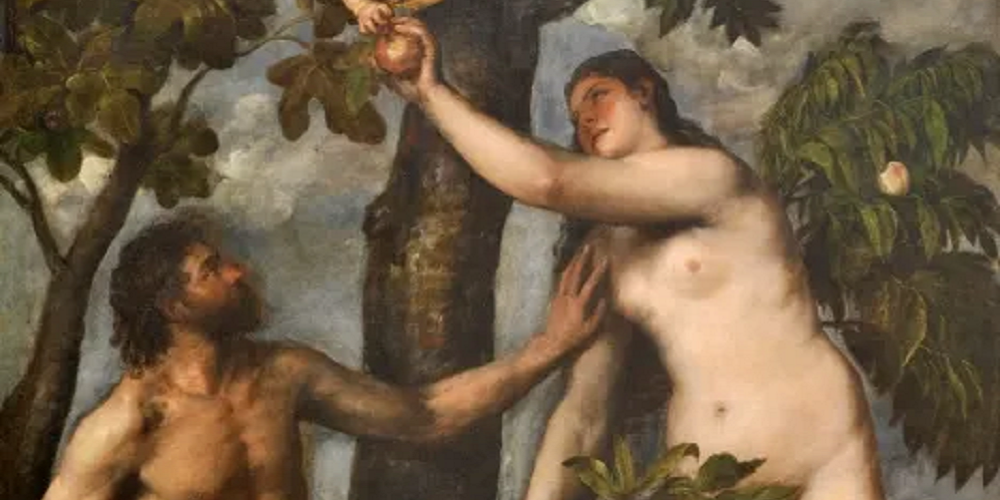
That terrible moment has come to us. The Church is being deceived like Eve was at the beginning of human history. When Eve was tempted in Eden, she was in the process of being prepared by her husband to fulfill her mission as mother, teacher, and queen of future humanity. From Adam, Eve received the commandments of God regarding the fruit of the tree of good and evil. From him, Eve also learned the names of all things, and the history of creation prior to her birth. Thus Eve was like a sacred vessel, prepared for a special mission: to teach all her children what Adam in turn had received from God. In her simplicity, Eve perhaps wondered if she was ever going to learn something by herself. The lying devil suggested to Eve that God selfishly reserved certain knowledge that she could obtain by eating the fruit of the tree of good and evil. (cf. Genesis 3:1-6) With that trick, the demon planted his own envy —like the venom of a serpent— in the innocent heart of the woman. He made her covet the forbidden fruit as the source of the special wisdom that she longed to possess. Perhaps Eve dreamed of teaching something to Adam, surprising him with her newly acquired knowledge. (See The Ascent of the Two Avarices, in this blog)
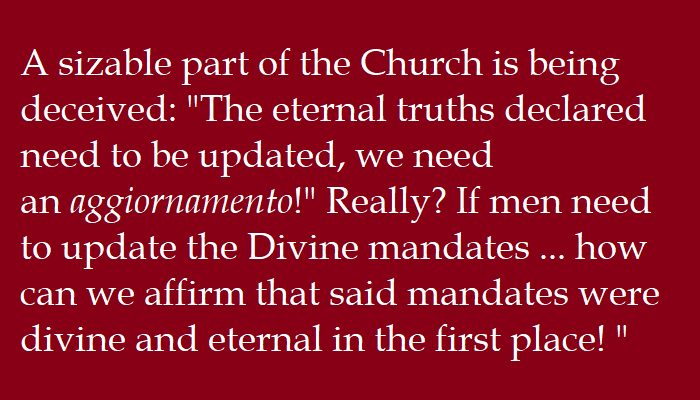
A sizable part of the Church is being deceived: “The eternal truths declared need to be updated, we need an aggiornamento!” Really? If men need to update the Divine mandates … how can we affirm that said mandates were divine and eternal in the first place! ”
Two laws were given to mankind in the Garden of Eden. The first was positive: “Be fruitful and multiply, and fill the earth …” The second was negative: “… of the tree of the knowledge of good and evil you shall not eat, for in the day that you eat of it you shall die.”
The positive mandate is tied to life, light and Logos the Master that Adam and Eve knew personally as He walked in the Garden.
“In him [Logos] was life, and the life was the light of men. The light shines in the darkness, and the darkness has not overcome it.” (John 1:1-3)
The negative mandate was tied to death: “… of the tree of the knowledge of good and evil you shall not eat, for in the day that you eat of it you shall die.” But the devil managed to engage Eve in conversation and adroitly accused God of being the liar and a deceiver:
“But the serpent said to the woman, ‘You will not die; for God knows that when you eat of it your eyes will be opened, and you will be like God, knowing good and evil.’” (Genesis 3:1-7)
Thus darkness was sold to Eve as the light of knowledge, and death as a superior form of life: “But the serpent said to the woman, ‘You will not die …’” A lie was represented to the woman as a liberating truth. Thus sin, which is darkness, death and a lie entered in the lives of Adam and Eve when future mankind was still contained in them. The violation of the negative law (“you shall not eat etc.”) distorted right then and there the results of the positive law (“Be fruitful and multiply.”) In that manner, Adam and Eve were to produce offspring stained by sin and death.
It is remarkable that the Septuagint Translation (LXX) renders both the tree of Eden and the Cross of Calvary with the same Greek word: xylon ( ξύλον lit. wood, tree, tree-trunk.)
Between the loss of Paradise and the moments described in Matthew 16 mankind experienced the bitter fruit of knowing good and evil. By now we should know that God is good and a benefactor. God wants the best for us. Resisting his love is madness. Running to the arms of the enemy is an even worse form of madness.
In the parable that Christ constructed with Peter at the center, he lovingly showed us that even good and sincere men can be quickly transformed. As the Church abandons divine thoughts to embrace deceptive doctrines of dubious inspiration, we must remember that we are living prophetic times:
“Now the Spirit expressly says that in later times some will renounce the faith by paying attention to deceitful spirits and teachings of demons through the hypocrisy of liars whose consciences are seared with a hot iron. (1 Timothy 4:1-2)”
In my humble opinion, the Church, as the Bride of the New Adam (Christ) is now experiencing something akin to the temptation of Eve. Our kind anonymous reader asks:
“This seems to be the ancient priestly failure of the Bible; an historically recurring cycle. But what do we do? Stop going to mass? Wait for God to light a lamp? Become protestants and go Sola Scriptura? What to do? I really don’t know and I am increasingly anxious.”
We were warned by St. Paul in 2 Thessalonians 2:7-12
For the mystery of lawlessness is already at work, but only until the one who now restrains it is removed. And then the lawless one will be revealed, whom the Lord Jesus will destroy with the breath of his mouth, annihilating him by the manifestation of his coming. The coming of the lawless one is apparent in the working of Satan, who uses all power, signs, lying wonders, and every kind of wicked deception for those who are perishing, because they refused to love the truth and so be saved. For this reason God sends them a powerful delusion, leading them to believe what is false, so that all who have not believed the truth but took pleasure in unrighteousness will be condemned.
The instructions for that time are in the same letter:
So then, brothers and sisters, stand firm and hold fast to the traditions that you were taught by us, either by word of mouth or by our letter. (2Thessalonians 2: 15)
The days of the fulfilling of every pure desire are coming. That unknown thing we need to fill the empty space in our souls is approaching. Even carrying the cross of our imperfections, our many sins, our own stupidity … we can do better than Eve. We have now knowledge of good and evil. God did not lie. God was right when He warned Adam and Eve.
We are approaching a better tree, the Cross of Christ. We should follow the example of Mary who coveted the Cross where her Son was nailed to. The old tree in Paradise was nothing but the entrance to this hellish present. The blessed tree, the Cross of Calvary is the door to Heaven.
“Fear not, little flock, for it is your Father’s good pleasure to give you the Kingdom.”

 Quod scripsi, scripsi
Something that may be added to this: the two ends of Peter’s plight in Matthew 16 represent light (“Blessed are you Simon son of Jonah!”) and darkness (“Stand behind me, Satan.”) That last thought seems to represent Christ Jesus future encounter with the Antichrist whose doctrine will contain a denial of the Cross. The Church may deny Christ three times just as Peter did but the Barque of the Fisherman will arrive safely to shore where Jesus will be waiting to forgive three times as well. (cf. John 21:1-19 paying attention to the phrase “three times” — is the third time that Jesus appears to the disciples after the Resurrection, and Peter is asked three times “Peter, do you love me?” Responding affirmatively three times.)
Perhaps all these things are meant to send the Church “into the wilderness” of purification before Christ arrives..
Here is a video with some thoughts worth considering whether we agree with it or not.
https://gloria.tv/post/4BuEs2ntneE749mzdiA1MUjov
LikeLiked by 1 person