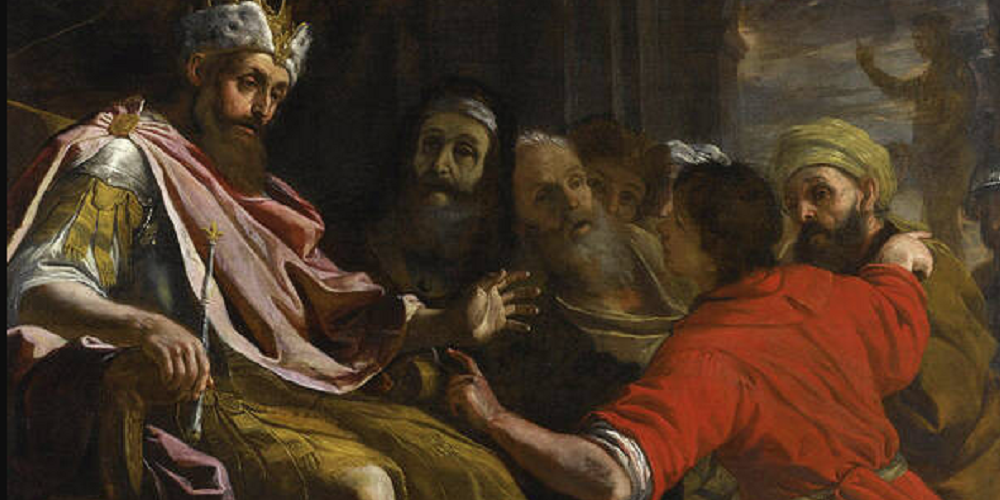
“But the thing displeased Samuel when they said, ‘Give us a king to govern us.’ Samuel prayed to the Lord, and the Lord said to Samuel, ‘Listen to the voice of the people in all that they say to you; for they have not rejected you, but they have rejected me from being king over them.” — 1 Samuel 8:6-7
Rejecting God and His justice seems to be the never ending vocation of mankind. Israel does that many times as told in the Old Testament in spite of every instance resulting in destruction and suffering. Some are gluttons for punishment as the popular saying goes.
The answer to Israel’s demand was Saul from the tribe of Benjamin. He liked to do things his own way. Of course, his reign ended badly. He fell on his own sword to avoid who knows what awful humiliations by his enemies. Many centuries later another man called Saul (known as Paul of Tarsus to the Christians) appealed to the Roman Emperor (Nero) when he was falsely accused. (See Acts 25.) Our St. Paul trusted himself to the justice of Nero. If he had kept his mouth shut and truly trusted in God … he would have been liberated in Ephesus. But he was a Roman citizen and had the right to appeal to Caesar. That decision was costly: he lost his head. Nero had no sympathy for Jews or Christians. Sometimes men reject God by appealing to minor deities or worldly powers. The populace of Jerusalem committed an even greater mistake when they rejected Christ, the man that was appointed to be their king forever.
[Pontius Pilate] said to the Jews, ‘Here is your King!’ They cried out, ‘Away with him! Away with him! Crucify him!’ Pilate asked them, ‘Shall I crucify your King?’ The chief priests answered, ‘We have no king but Caesar!’ Then [Pilate] handed Jesus over to them to be crucified. (John 19:14-16)
And so the nation began another unnecessary long journey of suffering. The humble Rabbi was not what they had in mind. Like the ones who “called Saul” in ancient times, they wanted someone more like a great general who could win battles, conquer the world, etc. They wanted a kosher Alexander the Great.
Because of that decision, the universal mission of Israel passed on to the Church in Pentecost. The New Israel was anointed the following Pentecost and went to conquer the Roman Empire in a way slightly less militaristic than the mobs of Jerusalem imagined in 33 A.D. And thus the House of the God of Israel became a house of prayer for all the nations. (See Isaiah 56:7) By deciding to reject Christ, Israel became like Saul while the Church became like David.
Few remember the decision of the religious leaders of Israel. Perplexed by the appearance of the wise Rabbi that could resurrect the dead, cure the lepers and the lame, etc. etc. but would not declare himself king … a man who appeared at the exact time predicted by the prophets but refused to come into Jerusalem riding a white horse sword in hand … The man Jesus of Nazareth was too much of a riddle. So, they decided that the Messiah was not a single man but a class of men: themselves! The tribe of Judah had survived to restore Israel and conquer the world. They did not have a Temple any longer, they did not have an army but they trusted they were astute enough to find a way to bring the prophecies to fulfillment. Their struggle continues to this day.
That is why I cringe when I hear the expression “Judeo-Christian Civilization” which is to say something like an “oil and water mix.” The restoration of ancient Israel is antithetical to Christianity no matter how sincerely some want to make that union possible. Christendom was built (and lost) by Christians however offensive some may find that obvious assertion. Since we are so close to Christmas let us remember the promise of Gabriel to Our Blessed Mother:
The angel said to her, ‘Do not be afraid, Mary, for you have found favor with God. And now, you will conceive in your womb and bear a son, and you will name him Jesus. He will be great, and will be called the Son of the Most High, and the Lord God will give to him the throne of his ancestor David. He will reign over the house of Jacob for ever, and of his kingdom there will be no end.’ (Luke 1:30-33)
I’m sorry for the mob of 33 A.D. Nice try but no cigar. The door is open. You can come in anytime even if it is two millennia late. Jesus loves you.
The brief preceding stories should show how easy is to reject God out of stubbornness, confusion, ignorance, or pride. It should teach us also about the serious consequences of opposing God. One is free to be like Saul or like David but the will of God will be accomplished with or without us. A deep mystery worth meditating about.
What is God doing?
The will of God is something truly simple: He wants to love us, He wants us to be happy with Him forever. We are currently enduring the results of our own disobedience. We rejected Him at the Garden of Eden. We should have been a race of happy gardeners, expanding Eden to the confines of the Earth while letting Him be our King and rule our lives. Isn’t it remarkable that after the Resurrection Jesus first appears to Mary Magdalen as a gardener? Everything Christ does has a meaning, He is the Logos after all, the Word that made everything. We were made for Him but we wandered away from the beautiful life He had prepared for us and now we have a chance to “do it our way” — our hard work, our infirmities, our wars, our hunger, our murders, our thievery, our politics, our taxes, our heartbreaks, our disgraces galore, our death … our fall.— Appearing as a gardener immediately after his resurrection shows that his purpose can be delayed by human disobedience but never changed. One day we will return to the Garden to complete the unfinished task.
Yes, because men were made to grow and mature in the garden of Eden but now we inhabit a giant Gethsemane where flesh and blood can only experience loss and pain. In fact we live and die leaving behind the product of our hard work. Weary hearted we advance towards the grave. It is hard to “be like God knowing good and evil,” uh?
But just remember … God’s will is always accomplished. Love never fails. He is all good and the ultimate benefactor. He loves us. If we only trust Him all will be well.
[To be continued]

 Quod scripsi, scripsi