
Tomás González Pondal
I will touch on a subject that few care about, is indifferent to many, and for many others has become an object of lively ridicule. What I am going to talk about I learned through the testimony of a great friend.
As everyone knows, there are several ways to die: some people die suddenly, for example, while asleep; others die in a traffic accident; others die from some illness; others are murdered, and the more gruesome these murders are, the more they shock people. Let us pause for a moment on these latter cases.
Here is a terrible homicide in which a man is found dismembered. The media, both local and national —and sometimes even international media— report the news. The police, the investigators, the courts of law, in short, a whole system is put in motion trying to clarify what happened, to do justice. The culprit is known: a neighbor.
Now, let’s imagine the following: the man who was found guilty and must spend some time behind bars says to the judge: “Your Honor, before I go to serve my sentence, I will go to celebrate the birthday of the woman I widowed, a woman who, as everyone knows, loved her husband dearly. So, I will celebrate in style with her, her children and family, and then I will go to prison. I clarify that I am not invited to celebrate with them, but I will go anyway, because I want to enjoy a feast and eat the delicacies they present there.”
Let us now imagine these words from the magistrate: “Phenomenal, sir. Go ahead and celebrate in style. Have a great time. Send my regards to the widow, who, I have no doubt, will be happy to see you.”
The Modernist monster
Well, what would you say to me in response to that? You will say: stop rambling, stop thinking nonsense!
What was quite rightly called “rambling” is, in another context a million times worse. The hoax is extremely serious. For some time now, the ecclesiastical fashion of making those who are in mortal sin take communion has been established, and this on the condition that they later go to the confessional.
“Even if you are in mortal sin, go to Communion, then confess afterward,” some priests maintain.
Yet another of the modernist inventions, another monster that they want people to consume as if it were something Catholic.
Let us remember what the Catholic Church has always taught us: “To make a good Communion, three things are necessary: 1st, to be in God’s grace; 2nd, to observe the proper fast; 3rd, to know what one is going to receive and to approach Communion with devotion” (Answer to question 630 of the Catechism of St. Pius X).
Adulteration
The following is swift condemnation against the diabolical conduct of certain priests: “Anyone who knows that he is in mortal sin must make a good confession before receiving Communion, since the act of perfect contrition without confession is not enough for him to receive Communion properly” (Answer to question 632 of the indicated Catechism).
Note this further: “Why is it that even the act of perfect contrition is not sufficient for one who knows that he is in mortal sin to be able to receive Communion? Because the Church has established, for the greater reverence of this sacrament, that one who is in mortal sin should not dare to receive Communion unless he has first confessed” (633).
And now, pay attention to the following; note what the inventors of an adulterated Catholicism—which is as false as it is mortal— are leading to: the Catechism asks, “Would he who received Communion in mortal sin receive Jesus Christ?” (634), and answers: “He who received Communion in mortal sin would receive Jesus Christ, but not his grace; rather, he would commit a sacrilege and would be worthy of the sentence of condemnation.”
Mortal sin kills the grace of God in souls, it puts man at enmity with the Trinity that loves him so much.
If the widow in the example should not be ridiculed by the victimizer presenting himself at her birthday, by analogy and by elevation, —with much more reason— it is impossible to present as something good to commune with Christ being mortally separated from Him.
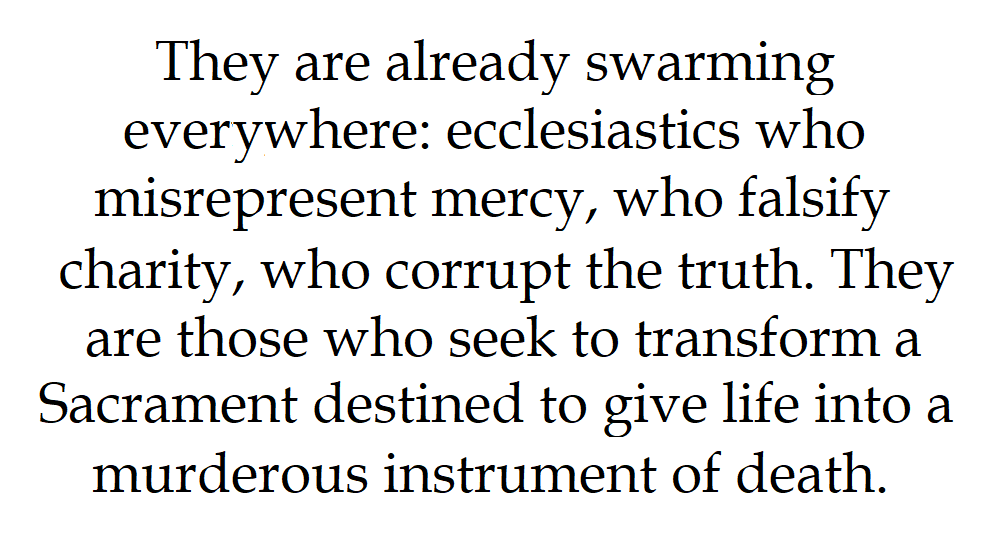
They are already swarming everywhere: ecclesiastics who misrepresent mercy, who falsify charity, who corrupt the truth. They are those who try to transform a sacrament destined to give life into an instrument to continue killing.
They are not instruments of medicine, they are instruments to kill. They do not lead from death to life, but opposed to life they abound in the domain of death. They do not take souls from the clutches of the devil, they take souls from the loving arms of God.
Everything has its impeccable logic, because it is logical that those who do not respect the Most Holy Eucharist do not respect the sacrament of Penance.
Modernism is the heresy that, among other forms of madness, does not fear to brazenly go against common sense.
Modernism is such a monstrous movement that, although it may be incomprehensible to some, it kills even the dead. It adds death to death, and, as I never tire of pointing out, it does so by pretending to be Catholic.
May God always give us good confessors, assist them with His strength, and may we never lack them in our earthly militia.

“And taking bread, he gave thanks, and brake; and gave to them, saying: This is my body, which is given for you. Do this for a commemoration of me.” — Luke 22:19 DOUAY RHEIMS 1888
Video about the consequences of the present disorder of the Roman Catholic Church and the world.
Click here.
 Quod scripsi, scripsi