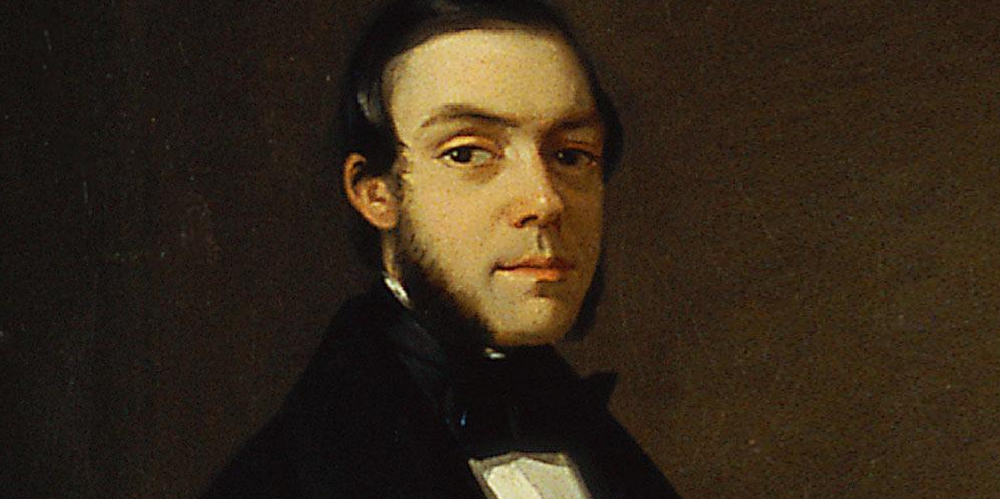
Maximiliano Barrio Gozalo
He was born into a family of wealthy landowners. He learned his first letters and grammar in Don Benito, the place where the family lived. In 1820, when he was eleven years old, he went to the University of Salamanca to study Arts, but in 1821 the College of San Pedro de Cáceres was reopened and for two years he studied Logic, Metaphysics and Ethics there. In this city he became acquainted with the family of José García Carrasco, a defender of Liberalism, and met his youngest daughter, Teresa, who eight years later became his wife. In the summer of 1823, Donoso spent the summer holidays in Cabeza de Buey (Badajoz), where he met the liberal Manuel José Quintana, who had retired there in anticipation of the imminent restoration of absolutism. In the following summers they meet again and establish cordial relations, to the point that Quintana presents him as “a subject who, in the few years he has, combines an uncommon talent, an education and a strength of reason and discourse that are even rarer. He is dialectic and controversial […] He is, in short, the son of my prayers, a trustworthy friend.”
After finishing his studies in philosophy, he went to Seville to study law. During the five years he stayed in this city, in addition to studying law, he cultivated romantic poetry and came into contact with the works of Locke, Condillac… After finishing his studies and graduating in Law, he moved to Madrid, hoping to place himself in the centre of politics and culture, and thus make his way in life. He was recommended by Quintana, Agustín Durán and other friends of his father. He came into contact with literary and political circles and became aware of real life. Things must not have gone very well for him, because he returned to Don Benito.
At the beginning of the following academic year, 1829-1830, Quintana refused the chair of Aesthetics and Literature at the College of Cáceres, but he suggested Donoso Cortés, who accepted reluctantly. His return to Cáceres brought him back into contact with the García Carrasco family, whose children had already returned from the exile imposed by the Reactionaries, and within a few months he married Teresa, the youngest daughter, thus linking himself to a powerful and influential Liberal family in Extremadura and Madrid. For the next two academic years he seems to have been retired in Don Benito, helping his father in the law firm and seeking a certain degree of obscurity. He read philosophers and romantics and completed his intellectual training with a view to entering public life and politics.
In mid-1832 he settled with his wife in Madrid. The repeal of pragmatism that Ferdinand VII had published two years earlier so that his daughter Isabel could succeed him and the “events of La Granja”, reestablishing the succession of his daughter and appointing a new government presided by Cea Bermúdez, gave Donoso the opportunity to send the Monarch a comprehensive report on the Law of Succession and the significance of what happened at La Granja. This report indicates his unconditional position on the side of Maria Cristina, and earned him the appointment of official of the Secretariat of Grace and Justice, thus beginning his career in the court bureaucracy that one day led him to become one of the leading figures in national politics. After the death of Ferdinand VII (1833), he gradually forgot about poetry and wrote more and more about politics, beginning an intense journalistic activity for the dissemination of Liberalism in those years of the Carlist war. In March 1834 he rose another step in his career and became Secretary of Decrees in the Ministry of State, but the massacre of friars that summer (July 17) impressed him and in the prologue to his Considerations on Diplomacy (1834) he asked the Government to fulfill its mission “defending the throne, consolidating liberty and suffocating anarchy.”
In the autumn of 1835 he was sent by the Government to Extremadura as a royal commissioner to try to ensure that the region obeyed the Queen and the central Government. His commission was successful, and he was appointed head of section in the Secretariat of Grace and Justice and later, secretary of the Cabinet of the Presidency and the Council. With the fall of Mendizábal he ceased to hold political office, but in the following elections he was elected deputy for Badajoz. He was twenty-seven years old and was beginning his long parliamentary career.
In October of that same year, 1836, the Madrid Athenaeum invited him to occupy one of its chairs and give some lectures on political law, which he gave from November 1836 to February 1837 and, in the opinion of Joaquín Costa, are comparable to the political treatises of Francisco Suárez. These lectures are the most complete exposition of the political ideology of the moderate Liberal that was Donoso [at that time] and point to some signs that his mentality was beginning to drift towards new orientations. In the following three years he continued with his intense journalistic activity and inaugurated his career as a parliamentary speaker as a deputy for the province of Cádiz.
On 27 July 1840, she asked permission from her Department of Grace and Justice to go to France to take healing baths, although it is conjectured that she did so to be at the side of Maria Cristina, who was going to renounce the regency and leave Spain. The truth is that when she arrived in Marseille on 18 October, Donoso Cortes was waiting for her there and there she wrote a manifesto that the Queen Mother addressed in farewell to the Spanish nation. She accompanied her to Paris and came into contact with French society and intellectuals. Maria Cristina named him a member of the Council of Guardianship of the Princesses Isabel and Maria Fernanda and entrusted him with the delicate mission of going to Madrid to try to arrange with Espartero the matter of the guardianship of her daughters, but it was all in vain.
The Courts and the Government did not recognize María Cristina’s guardianship and she did not want to give up her maternal rights. Donoso returned to Paris and joined the group of moderate political emigrants, which included Martínez de la Rosa, Alcalá Galiano, generals O’Donnell and Narváez, etc. He remained in Paris until October 1843, when, after the fall of Espartero, he returned to Spain, and from there he wrote in El Heraldo some “Letters from Paris”, in which he showed interest in French political and intellectual movements and in which some traces of the French traditionalists can be observed, no doubt because, without realizing it, he was becoming less and less Liberal and less of a Rationalist.
The fall of Espartero (1843) opened the doors to political exiles from Paris and Donoso returned to Spain, being elected deputy again for his native province of Badajoz. On 6 November he defended in the Courts the proposal to declare Isabel II Queen, despite being only thirteen years old and not fourteen, as required by the Constitution. The proposal was approved and on 8 November Isabel II was acclaimed Queen of Spain, who shortly after chose Donoso as her personal secretary and asked him to travel to Paris to negotiate the return of his mother, while trying to create a favorable environment for the return of Maria Cristina, publishing at the end of 1843 a History of the regency of Maria Cristina.
With the moderates in power and the Queen Mother in Madrid, Donoso had a great influence on the course of Spanish public affairs. General Narváez took charge of the Government (1844), dissolved the Cortes and called another one to, once again, start anew. In the three crucial matters that were submitted to the new Cortes: reform of the Constitution of 1837, reestablishment of relations with the Holy See and marriage of the Queen, Donoso, who had a seat in Badajoz, intervened decisively.
Appointed secretary of the Commission to reform the Constitution, he seems to have been the architect of the new Fundamental Law, more conservative than the previous one and in line with his own ideology. He presented the Commission’s opinion to Congress and the New Constitution was approved.
In 1845, Queen Isabel II appointed him Chamberlain and the problem of her marriage arose, with as many sides forming as there were possible suitors. Donoso had suggested to the Queen Mother in 1842, while they were in Paris, the name of the Count of Trapani, Maria Cristina’s brother, as a possible husband. But when he returned to Spain, considering the contrary reactions of the same moderates and the press, [Donoso] declared that this marriage was completely impossible, “because my conscience tells me that voting in his favor is against the throne of my Queen and Lady Isabel.” This position displeased the Courts, although it does not seem that he fell into disgrace, but rather prudently distanced himself from it, since on the occasion of the royal wedding (16 October 1846) Donoso was granted by Royal Order of 12 December 1946, with the prior Viscounty of Valle, a title of Castile with the name of Marquis of Valdegamas for himself and his descendants, as a Grandee of Spain, and in 1847 he accompanied María Cristina on a trip to France.
His Christian faith
In 1847, when he was thirty-eight years old, a profound change took place in Donoso, and his life became a living testimony to his Christian faith.
The remaining six years of his life were years of plenitude and maturity, during which he wrote the Essay and gave the great speeches that resonated throughout Europe; the years in which his figure as a diplomat filled the Chancellery of Paris and Metternich, Louis Napoleon and Pius IX listened to him with pleasure and asked for advice. From then on, his writings, speeches and actions were inspired by Catholic ideology.
In January 1848 he published two volumes with a collection of his selected works, and the Athenaeum of Madrid elected him president of the section of Moral and Political Sciences, and the Royal Spanish Academy offered him a seat. Narváez, head of the Government, several ministers and the intellectual and aristocratic elite of Madrid attended his inauguration, where he gave the inaugural address on the Bible. During this time he was responsible for instructing Isabel II in historical matters and to this end he wrote Studies on History, which Gabino Tejado published under the title Historical Philosophical Sketches, which are an essay on the philosophy of history.
The revolution of February 1848 in France and the subsequent revolts throughout Europe also reached Spain in the form of riots. The Courts granted extraordinary powers to General Narváez, who was then in power, to oppose the revolutionary wave, but his repressive policy earned him the opposition of the Progressives. On January 4, 1849, at one of the moments when Narváez was being most violently attacked, Donoso gave his famous speech on dictatorship in the Courts, in which he stated that society was in danger and must be saved at any price, “when legality is enough to save society, legality; when it is not enough, dictatorship.” And since one must choose between two dictatorships, the one that comes from below and the one that comes from above, “I choose the one that comes from above.”
The speech caused a huge sensation in Spain and Europe and many newspapers reproduced it.
Appointed Spanish Plenipotentiary Minister in Berlin (6 November 1848), he went to his new post without knowing German and without any special sympathy for the people. The foggy and cold climate did not suit him well and in October 1849 he returned to Madrid. He did not have much political life, but he did have enough to win the friendship of the ambassadors of Sweden and Belgium and to become close friends with the Russian ambassador, who had admired his speech on the dictatorship and had sent him to Moscow.
On his way back to Paris he visited Montalembert, who introduced him to the man who would later become his great friend: Louis Veulliot, an ardent French Catholic propagandist. At the end of November he arrived in Madrid and took an active part in political life. In January 1850 the Courts were discussing whether the Government could draw up the national budget itself or whether each item should be studied and approved in public debate. The commission asked Donoso to summarize the debate and he gave another of his great speeches, known as the Speech on Europe, in which, with admirable intuition, he sees in Russia and in the confederation of the Slavic races the true danger for Europe if one day socialism, by stripping men of private property, also deprives them of love for their country. Europe is moving towards republicanism, because the revolution is far from being defeated and, if it is not stopped, it will lead to communist atheism. “The radical remedy against revolution and socialism,” he continued, “is none other than Catholicism, because Catholicism is the only doctrine that is their absolute opposite.” In the autumn of 1850, tensions within the government forced the resignation of the Minister of Finance, Bravo Murillo, but the prestige of President Narváez fell and the moderate party split. Donoso broke with the party for which he had fought so hard and on 30 December, on the occasion of the government’s proposal to authorize it to dispose of taxes before the approval of the budget, he gave the Speech on the Situation of Spain in the Courts. What bothered Donoso was that the government was more concerned with material interests than with religious, political and social ones, the concern of everyone for prosperity and enjoyment, as well as the corruption that was corroding Spanish society. The same night of the speech, Narváez presented his resignation, which was accepted by the Queen.
Donoso was already far from being a moderate liberal and was hardly a politician. He was now a philosopher of society and history who beat anyone who did not accept the principles of Catholicism in the free field of ideas, even if his name was Narváez.
He was working on a book that was to systematically contain his new ideology, which was published simultaneously in Spain and France under the title Essay on Catholicism, Liberalism and Socialism (1851). The book, like everything else Donoso had already published, caused a sensation and created controversy, to the point that he could proudly say that “no book has caused such a sensation in France in recent times.” The Madrid press, on the other hand, barely commented on the work.
When the Essay was published, Donoso was already back in Paris, and this time he did not want to return to Spain.
Bravo Murillo’s government had sent him as plenipotentiary minister. The resonance of his speeches and his Essay had made him famous in France and, as soon as he set foot in Paris, the doors of all the fashionable salons were opened to him, even before presenting his credentials to Louis Napoleon, who found in him a theorist of his anti-revolutionary purposes.
Thus, when he heard him at an audience express his views on the revolution, on France and Europe, “joy and satisfaction overflowed from all sides. Thank God,” he said, “that I found a man, and a foreigner, who is more informed than the French about the state of France.” This mutual esteem contributed to cordial relations between France and Spain and to the French police working with the Spanish Government to dismantle Carlist and Republican conspiracies. The dispatches that Donoso sent to Madrid are invaluable documents to know to what extent he followed all European politics and how accurately he judged it.
From Paris he also followed all the intrigues in Spain.
Gabino Tejado and Count Raczynski, Prussian ambassador in Madrid, kept him well informed.
It was rumored that he might be offered to form a government in Spain, but he said that it would be very difficult and impossible for him to accept, because “I am too rigid, too absolute and dogmatic to suit anyone and for anyone to suit me.”
Public life, which a diplomat of his rank could not avoid, occupied much of his time, but he also had time to publicly defend his Essay from its detractors. The one that hurt him most was that of a French priest who challenged some concepts as being inconsistent with the Catholic faith, although what was actually being aired was an attack by liberal Catholicism against Roman and monarchical Catholicism.
In 1852, Cardinal Fornari, prefect of the Congregation of Studies, who had met Donoso in Paris, sent him a report containing the main philosophical and theological errors of the time, in order to obtain his opinion. Donoso responded with a masterly letter in which he analyses the main social and political errors of the time, showing how they are based on and are deduced from a few erroneous principles in religious matters.
His is possibly the document of the time that makes a more orderly and profound dissection of the dominant ideology in Europe and a more profound critique of Liberalism.
If all the aspects outlined are important to understand Donoso’s personality, there is one in the last stage of his life that is decisive to understand him: that of his religious life, because from the day he decided to live as a Catholic with all the consequences, his existence took a markedly ascetic course and one of helping those in need. In April 1853 a violent heart condition put his life in danger, he overcame the crisis, but towards the end of the month it worsened again and a few days later he died.
Count Hübner, Austrian ambassador and personal friend of Donoso, says that “he was a profound and original spirit, such as the golden age of Charles V had produced in abundance in his country, and of which the present age produces very few, especially in Spain.”
Donoso Cortés married Teresa García Carrasco in 1830, who died suddenly in Cáceres on 3 June 1835. The only daughter born to the marriage had died a year earlier. Donoso did not remarry.

Works
The electoral law considered in its foundations and in its relation to the spirit of our institutions, Madrid, publ. by Imprenta de Tomás Jordán, 1835; Lectures on political law, Madrid, publ. by Imprenta de la Cía. Tipográfica, 1837; Constitutional principles applied to the draft fundamental law presented to the Courts by the commission appointed for that purpose, publ. by Madrid, Cía. Tipográfica, 1837; Selected collection of the writings of His Excellency Mr. Donoso Cortés, Marquis of Valdegamas, Madrid, publ. by Ramón Rodríguez de Rivera, 1848, 2 vols.; Speech given on January 30, 1850 in the Spanish Courts,; Essay on Catholicism, Liberalism and Socialism considered in their fundamental principles, publ. by Madrid, M. de Rivadeneyra, 1851 (the French edition was published in Paris at the same time); His Works, ed. by G. Tejado, publ. by Madrid, Fejada, 1854-1855, 5 vols.; Letter to His Eminence Cardinal Ferrari, on the Generating Principle of the Most Serious Errors of Our Days, publ. by Madrid La Armonía, Sociedad Literaria-Católica, 1865; Complete Works of Juan Donoso Cortés, Marquis of Valdegamas, ed., intr. and notes by C. Valverde, Madrid, publ. by La Editorial Católica, 1970, 2 vols. (Library of Christian Authors, vols. 12-13).
Bibliography
F. J. Buss, Zur katholischen politik der Gegenwart, Paderborn, 1850; B. D’Aurevilly, Les prophètes du passé, Paris, 1857; L. Veuillot, “Introducción”, en Oeuvres de Donoso Cortés, Paris, 1858-1859; J. F. Pacheco, Literatura, historia, política. Sobre el marqués de Valdegamas, Madrid, Imprenta de J. Peña, 1864, 2 vols.; A. D’Antioche, Le Comte Raczynski et Donoso Cortés, dépêches et correspóndanse politique (1848- 1853), Paris, 1880; J. Becann, “Donoso Cortés”, in Lexikon für Theologie und Kirche, 3 (1931), págs. 412-413; L. Fischer, Der Staat Gotees, eine katholische Geschichtsphilosophie von Donoso Cortés, Karlsruhe, 1933; E. Schram, Donoso Cortés. Leben und Werk eines spanischen antiliberalen, Hamburg, 1935; P. Leturia, “Prevision and rejection of communist atheism in the last writings of Juan Donoso Cortés”, in Gregorianum, 18 (1937), pages. 481-517; D. Westemeyer, Donoso Cortés. Staatsman und Theologe, Münster, 1940; F. Aragües, Donoso Cortés: Liberalismo y Estado católico, Zaragoza, 1941; J. Corts Grau, “Perfil actual de Donoso Cortés”, en Revista de Estudios Políticos, 10 (1945), págs. 79-118; L. Díez del Corral, “Donoso Cortés, doctrinario. La Constitución del 45”, in L. Diez del Corral, El liberalismo doctrinario, Madrid, Instituto de Estudios Políticos, 1945, pp. 493-544; L. Legaz, La idea del Estado en Donoso Cortés y Vázquez de Mella, Santiago de Compostela, Editora Universitaria Compostelana, 1945; R. Calvo Serer, “Europa en 1849. Comentario a dos discurso de Donoso Cortés”, in Arbor, 12 (1949), págs. 329-354; F. Elías de Tejada, Para una interpretación extremeña de Donoso Cortés, Cáceres, Imprenta Provincial, 1949; B. Mecnzer, “Metternich y Donoso Cortés. Christian and conservative thinking in the European revolution”, in Arbor, 13 (1949), pages. 62-92
K. Sghmitt, Donoso Cortés in gesamteuropäischer Interpretation, Köhln, 1950; G. de Armas, Donoso Cortés, Madrid, Rivadeneyra, 1953; VV. AA., Africa in the thought of Donoso Cortés, cycle of conferences pronounced in the Instituto de Estudios Africanos, Madrid, Instituto de Estudios Africanos, 1955; VV. AA., Centenario del fallecimiento de Juan Donoso Cortés, speeches read in the public council celebrated by the Instituto de España, Madrid, Instituto de España, 1955; F. Gutiérrez Lasanta, Donoso Cortés, el profeta de la Hispanidad, Zaragoza, 1955; J. F. Acedo Castilla, Donoso Cortés y la revolución de 1848, Sevilla, Ateneo de Sevilla, 1956; J. Chaix-Ruy, Donoso Cortés, théologien de l’Historire et prophète, Paris, 1956; S. Galindo Herreros, Donoso Cortés y su teoría política, Badajoz, Diputación Provincial, 1957; A. Caturelli, Donoso Cortés. Ensayo sobre su filosofía de la historia, Córdoba-Argentina, Imprenta Universidad, 1958; M. Fagoaga, El Pensamiento Social de Donoso Cortés, Madrid, Ateneo, 1958; B. G. Monsegú, Clave teológica de la historia según Donoso Cortés, Badajoz, Diputación Provincial, 1958; F. Suárez Verdeguer, Introducción a Donoso Cortés, Madrid, Rialp, 1964; J. Larraz, Balmes y Donoso Cortés, Madrid, Rialp, 1965; C. Valverde, “Introduction general”, en J. Donoso Cortés, Complete works of Juan Donoso Cortés, op. cit., vol. I, pp. 1-156 [in pp. 157-166 has a complete bibliographic list on Donoso Cortés].
Source (in Spanish): Short Biography of Juan Donoso Cortés
The Author
Maximiliano Barrio Gozalo is Professor of Modern History at the University of Valladolid and member of the Spanish Institute of Ecclesiastical History in Rome. A good connoisseur of the documentary funds of the ecclesiastical archives, he has focused his historical research on a triple theme: the study of the clergy in modern Spain, Spanish-Italian relations in the 18th century through the correspondence between Charles III and Bernardo Tanucci, and slavery in Spain under the Ancien Régime, to which should be added his collaboration in different historical works for dissemination and his participation in numerous national and international scientific conferences. Among his many works, it is worth mentioning Slavery in the Western Mediterranean in the 18th Century (1980), Socioeconomic Study of the Church of Segovia in the 18th Century (1982), Charles III. Letters to Torucci (1988), The Economy of the Bishops in Spain under the Ancien Régime (1995), Slave Labor in the Arsenal of Cartagena (1997), The Financing of the Church and the Hospital of Santiago de los Españoles in Rome during the Modern Period (1998) and The Bishops of Castile and León during the Ancien Régime (2000).
 Quod scripsi, scripsi