“Many shall be purified, cleansed, and refined, but the wicked shall continue to act wickedly. None of the wicked shall understand, but those who are wise shall understand.” (Daniel 12:10)

This October 9 of 2024, I was reading my email when I happened to read a new message sent by a reader alerting me to a startling new discovery: Alessandro Massano —Italian astronomer— had presented his amazing findings only a few hours prior in a YouTube channel called Codice Ratzinger. I immediately visited the video and tried to digest its contents. I decided that I would share all of it with my readers. A good number of you understand Italian. I encourage those to watch the video in its entirety.
The first part of the 36 minute video is dedicated to a quick introduction to the basic story of Our Lady of Guadalupe. If any of my readers are not familiar with the story of Guadalupe, I encourage you to read my book Guadalupe A River of Light — The Story of Our Lady of Guadalupe from the First Century to Our Days.
The center of the story is the encounter of Juan Diego Cuauhtlatoatzin with Our Lady of Guadalupe at Tepeyac Hill about eight miles from the center of what is now Mexico City. I won’t repeat the story here but you can find a number of articles in this blog and other Catholic blogs that deal with the different aspects of the story.
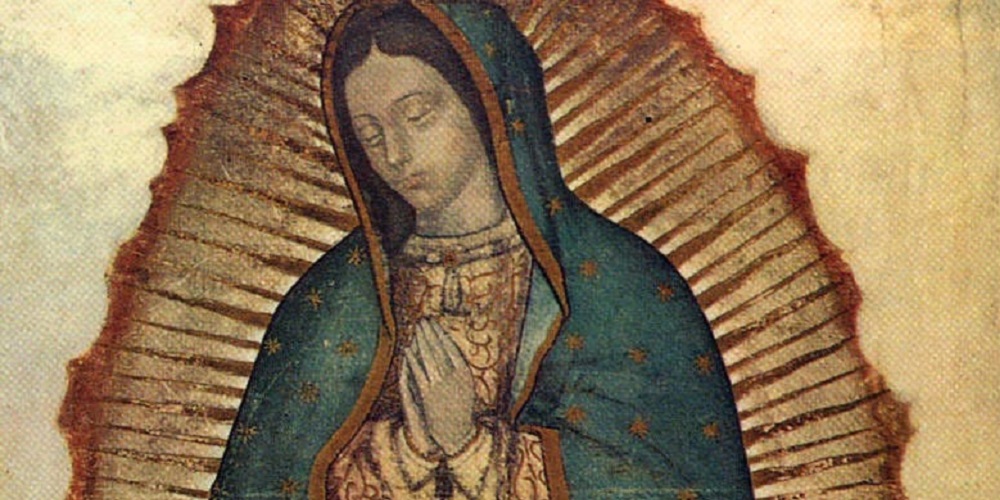
The miraculous image of Our Lady of Guadalupe that appeared on the tilma of Juan Diego in 1531 is in itself a sort of evangelium. Something like a gospel for those living in the Modern Age. It is composed as an amoxtli a document in the writing style of the Mesoamerican peoples of the 1500’s who use images to communicate ideas or describe events.
One of the most impressive details in the image is the mantle that Our Lady wears. Those ancient Mexicans understood the woman in the image was a princess because her mantle bore the royal color, a kind of amethyst green-blue decorated with golden stars in it. It took many years to discover that the stars depicted in the mantle reproduced exactly the heavens above Tepeyac Hill on December 12, 1531.
The mantle contains 46 stars. It is perfectly possible to identify each star by its relative position. The image of the sky is inverted mainly because the Aztecs —lacking telescopes— observed the night sky as it reflected on quiet pools of water built for that purpose. The method may seem a bit silly but it did wonders for ancient astronomers’ necks and eyes!
All things remaining the same, the stars in the mantle would have been a great wonder. But in our own days, professor Massano made an amazing and very timely discovery. There are 46 stars represented in the mantle of Our Lady and (since 12 December, 1531) there are 46 popes, the last being Benedict the XVI who died on December 31, 2022. Here is the correlation of popes and stars taken from the video by Prof. Massano interviewed by Andrea Cionci.
The columns indicate (left to right) Names of the 46 popes; Frequency (the number of Popes who took that name;) the Constellations to which the stars in the mantle belong to; and How Many stars of that constellation are present in the mantle of Our Lady of Guadalupe.
Observe and think of the coincidences between columns 2 (frequency) and 4 (stars present). Try to calculate the odds of such coincidence being produced.
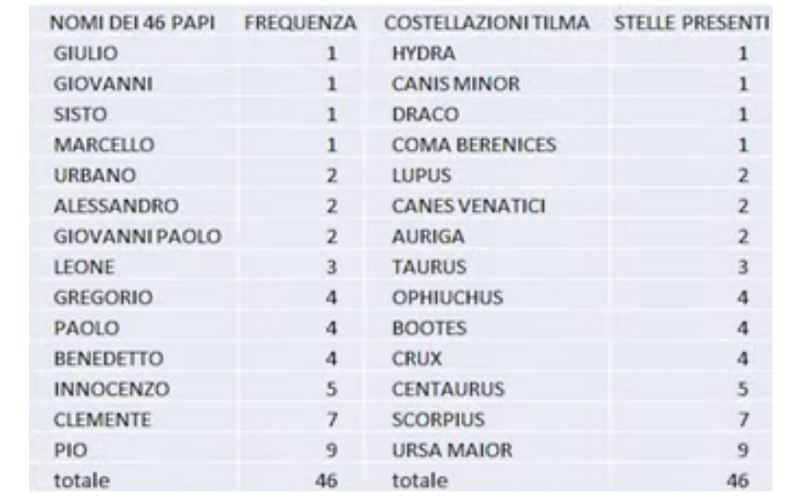
The names in English are (from top to bottom) Julius, John, Sixtus, Marcellus, Urban, Alexander, John Paul, Leo, Gregory, Paul, Benedict, Innocentius, Clement, Pio. At the time of the apparitions in 1531, the reigning Pope was Clement VII.
As you can imagine, there is much more to the investigations of Prof. Massano. This brief post was meant to simply introduce the discovery to my readers. In the days to come, I will translate the transcription of the complete interview, currently 11 pages in longhand. It has to be edited of some colloquialism, unnecessary repetitions and all those things that appear normally in verbal dialog. Once is clean and easily readable, I will translate it and present it to you.
My impressions at this point are many but I will concentrate in the coincidence between this list (above) and the list attributed to St. Malachi of Armagh. I have been bitterly criticized for believing in the list of St. Malachi. This is sort of a vindication because someone will have to explain how the “forgery” took place historically. I imagine there will be few volunteers. There is also the usual naysayer who will dismiss the whole thing out of hand. I already heard a few. One was hasty enough to argue that “46 apples and 46 pears will always have the number 46 in common!” He did not pass the Logic assignment in school. I can tell that. He also failed to watch the video graciously provided by myself and another blogger. All I can tell you is THINK (it used to be IBM’s motto: “Think!“) because the actual probability calculation for this “coincidence” between columns 2 and 4 is so low (involves a tiny number preceded by 67 zeroes after the decimal point) that is: a virtual impossibility.
To my mind, we are barely scratching the surface of Prof. Massano’s discovery.
Praise be to God who has revealed such wonders to his people in this age of darkness. And many thanks to Prof. Massano for his amazing discovery!

 Quod scripsi, scripsi
Here is an explanation in English.
LikeLike
I think we are in a moment similar to the pontificate of Annas and Caiaphas that was imposed by the Romans over the Jewish nation in Jesus’ time. The end of something big is at hand. Obviously it is not the end of the Church but perhaps this is the end of the Church’s mission.
This seems to me the moment when the Church escapes to the wilderness. The abomination is in place and concomitantly, the Church has ceased to speak the Gospel of Christ clearly through the chair of Peter.
Something important is ending.
(1) Moses took his people to the wilderness when the age of the Patriarchs ended and Israel marched towards the Promised Land
(2) Christ took His People (the Church, the New Israel) into the wilderness, into the nations so the promise of God could occur: “My house will be a house of prayer for all the nations!”
(3) In our days, Christ Himself is leading us into the wilderness one more time to be purified and ready for a Marian Age to come.
In my humble opinion, the papacy is now a mirage, a trick to deviate the Church into the wide path of worldly dissolution. See Revelation 12. It is all there.
The forces of evil will not prevail.
LikeLiked by 1 person