
Chapters 24 and 25 of the Gospel according to Matthew deal with the signs of the parousía and the end times. Considering the Scripture readings for this Sunday’s Mass we can see this mysterious Parable of the Talents. It is important to understand that a talent was literally a truckload of money more or less equivalent to 20 years of a laborer’s wages, according to some expert historians.
In my opinion, the most interesting feature is that the story seems to cover a long period of time, apparently beginning at the first century and ending when Christ returns.
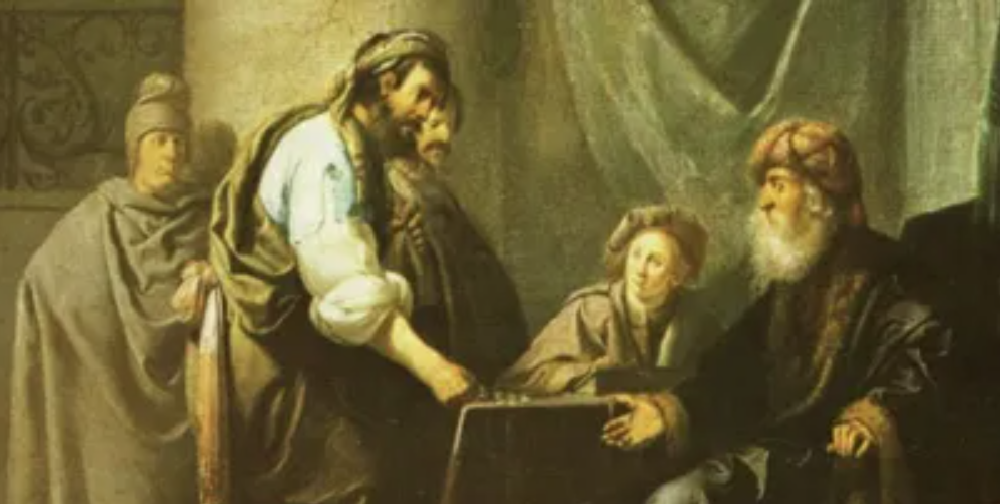
The Parable of the Gold Talents — Matthew 25: 14-30
“Again, it will be like a man going on a journey, who called his servants and entrusted his wealth to them. To one he gave five gold talents, to another two talents, and to another one talent, each according to his ability. Then he went on his journey. The man who had received five talents went at once and put his money to work and gained five talents more. So also, the one with two talents gained two more. But the man who had received one talent went off, dug a hole in the ground and hid his master’s money.” (vv. 14-18)
The master has three servants each with different abilities. Before going on an extended journey, the master trusts them three portions of his own wealth: five, two and —to the last servant— one talent. It is quite apparent that the master knew his servants well and was aware of each one’s aptitudes. That is reflected in the number of talents Jesus chose to place in the hands of these imaginary servants: 5, 2, and 1. The sum of the three numbers equals 8. Imagine a round cake to exemplify the proportions.

Numbers 8, 5, 2 and 1
One can plainly see that the eight portions are a natural way to split a circle evenly. If you love pizza as much a I do, I am sure you are familiar with this way of dividing a circle. Therefore 8 is not a random number used to show that ‘servant one’ had received 5 times more gold than ‘servant three’ and 2.5 more times than ‘servant two’.
The number eight represents a new beginning in Holy Scripture —where numbers are always carefully placed and always have a meaning— A week has seven days Sunday through Saturday. The following Sunday (Dominus Dei, the Day of the Lord) is day number 8. The week begins anew.
- In the mystery of Our Lord’s Passion, His glorious Resurrection happens on Glory Sunday on the eighth day since his glorious entrance in Jerusalem on Palm Sunday.
- After the seven weeks of the spring harvest season, the next day is Pentecost. This is the eigth day of the final week.
- After the seven days of Tabernacles there is an eigth and final day called the Last Great Feast Day.
There is much more to ‘number eigtht’ but this will suffice for now. All appears to point to, or be a model of, the renewal of the world when the appointed times are completed. Without falling into Dispensationalism (a heresy) one can see that God has really disposed things for a great renewal of the world that mankind foolishly ruined by sin and disobedience.
Now number five
A thick treatise could be written about the number five in Scripture. Jesus was wounded five times on the Cross of Calvary. Five are the books of the Law of Moses, the Torah. The New Testament begins with five books that tell about the birth of Jesus and the birth of the Church: Matthew, Mark, Luke, John and the Acts of the Apostles. The offerings at the Tabernacle and Temple comprised five kinds as well. We could continue until my alloted disk space is full. This is enough to show the point. You can research more “fives” including natural occurrences: i.e. five fingers and toes, etc.
The meaning of five is Grace exemplified perfectly by the five wounds of Christ. See Isaiah 53:5 and 1 Peter 2:24.
And number two
Two points at two things: establish the truth. See Matthew 18:16. Reproduction, duplication. The union of male and female for the preservation of the species by multiplication. See Genesis 6:19. And so many other scriptural examples that, again, it would take many pages to list.
Number one
Here it gets deep. No pun intended. The one talent that ends buried is a negation. One is the Aleph, the first letter of the Hebrew alphabet, there is only One God, and His First Commandment is to worship Him alone. See Ephesians 4:4-5. More on this number in a minute.
“After a long time the master of those servants returned and settled accounts with them. The man who had received five talents brought the other five. ‘Master,’ he said, ‘you entrusted me with talents. See, I have gained five more.’ His master replied, ‘Well done, good and faithful servant! You have been faithful with a few things; I will put you in charge of many things. Come and share your master’s happiness!’ The man with two talents also came. ‘Master,’ he said, ‘you entrusted me with two talents; see, I have gained two more.’ His master replied, ‘Well done, good and faithful servant! You have been faithful with a few things; I will put you in charge of many things. Come and share your master’s happiness!’” (vv. 19-23)
This parable may point at three main ages of the Church.
- The Apostolic Age, or the Age of the Gospel when the Church grew filling the ancient world with the Good News.
- The Age of Christendom during which the Church continued to grow and was established as the light of the world.
- The final Age of Apostasy, briefer than the other two, when weak and sinful men will attempt to bury the doctrinal treasure received from God. Those men filled with evil intentions apostasize in an effort to please the World or perhaps avoid persecution.
Then the man who had received one talent of gold came. ‘Master,’ he said, ‘I knew that you are a hard man, harvesting where you have not sown and gathering where you have not scattered seed. So I was afraid and went out and hid your gold in the ground. See, here is what belongs to you.’ His master replied, ‘You wicked, lazy servant! So you knew that I harvest where I have not sown and gather where I have not scattered seed? Well then, you should have put my money on deposit with the bankers, so that when I returned I would have received it back with interest. ‘So take the gold talent from him and give it to the one who has ten talents. For whoever has will be given more, and they will have an abundance. Whoever does not have, even what they have will be taken from them. And throw that worthless servant outside, into the darkness, where there will be weeping and gnashing of teeth.’” (vv. 24-30)
The worthless servant buries the barren gold as if it were a seed. Instead of giving it to the bankers where it can yield interest, he stupidly hides that enormous capital because he is afraid to lose it. That fear is unjustified, an excuse that reveals the servant’s laziness. Stupidity, fear and sloth are diabolic, unnatural. They produce nothing just as a golden coin planted in the ground is not going to grow a money tree. The act of the evil servant is a negation of the fruitfulness promised by God in Genesis 1:27-28. He does not have the interests of his master at heart. He does not care.
So we are introduced to grace: the first servant is given more and then “grace upon grace” is piled on him when he receives the talent of the lazy servant. He ends up in charge of three quarters of the master’s capital.
And we are also shown the second diligent servant. He is not as talented as the first but he concientiously does his best to duplicate the capital trusted to him. Both ‘servant one’ and ‘servant two’ duplicate what they have received. The third servant fails because his worthless behavior is not blessed.
Entering joy or entering darkness
The master “goes away” and “returns after a long time.” The parable clearly points at the path of the Church through history and it fits perfectly with other parables (i.e. Wheat and Tares) showing other facets of the same teaching. Christ was telling his disciples how history was going to develop and what should they expect to encounter as the centuries passed. For us, he left a much easier task because we are seeing history from the opposite end.
We live in the most dangerous part of this lesson. Our Master told us about the signs of his return on the previous chapter (Matthew 24) and in this parable he teaches us how he is going to compensate his servants for the work they have performed.
Imagine the reaction of Our Lord as he finds the fruitful work of some of his servants who manage to be productive in this dark and evil age. I am sure we cannot even imagine the joy Christ will bestow on them.
_____________
POSTSCRIPT: ‘servant one’ ending up with the lot of ‘servant three’ (the lazy, evil, good for nothing servant) suggests to my mind a return of some saints of ancient times to revive the Church ruined by those represented by the lazy servant. That is mentioned in many private revelations, one of which predicts that St Peter and St Paul will select a Pope to rule the renewed Church. Of course! Who would be better to revive the Church demolished by evil! In Mark 5: 21-43, when restoring the young girl to life, Jesus allows only a few of his earliest disciples to be present. (See Mark 5:37) The young girl is a figure of the Church at the end times with the mysterious woman who had had a flow of blood apparently representing fleshly Israel restored to God’s grace at the edge of the End Times. See He is Way, Truth, and Life.

 Quod scripsi, scripsi