
God is good and a benefactor, He is pure goodness. The devil is bad and malevolent, he is pure evil. Imagine the moral universe as a line or a road with two extremes. In one extreme there is a source of light that is good while on the other there is a total absence of light. That is where the prince of darkness resides. We are free moral agents, God has given us free will. When a free moral agent approaches God, the more abundant the blessings of God will be. The more one approaches the opposite end one will encounter more evil. Growth and happiness are on the goodness side, evil and annihilation await for the hapless soul that moves towards the dark side.
Light and darkness, order and chaos are recurrent themes throughout Sacred Scripture. We can find that theme in the first chapter of Genesis (cf. Genesis 1:1-5) and in many other parts of Scripture. The prophet Isaiah announces the arrival of Christ as a “great light” associating light with the end of dishonor for Zebulun and Naphtali and Galileans in general because among them will be born this new light, someone who will mark the beginning of a glorious renewal for Israel. The prophet uses the light/shadow theme to reinforce the joyful dawning of a new day:
Nevertheless, there will be no more gloom for those in distress. In the past He humbled the land of Zebulun and the land of Naphtali, but in the future He will honor the Way of the Sea, beyond the Jordan, Galilee of the nations: The people walking in darkness have seen a great light; on those living in the land of the shadow of death, a light has dawned. (Isaiah 9:1-2)
St. Matthew applies that prophecy to Jesus in Matthew 4:16 and then follows with a statement containing briefly the whole thrust of Christ’s message:
From that time Jesus began to proclaim, ‘Repent, for the kingdom of heaven has come near.’ (Matthew 4:17)
The prophecy of Isaiah is thus connected to the light and joy of Christ’s good news. (cf. John 8:12) St. John begins his gospel introducing us to the Word:
[εν αρχη ην ο λογος και ο λογος ην προς τον θεον και θεος …]
In the beginning was the Logos, and the Logos was with God, and the Logos was God. He was in the beginning with God. All things were made through him, and without him was not any thing made that was made. In him was life, and the life was the light of men. The light shines in the darkness, and the darkness has not overcome it. (John 1:1-5)
St. John reveals to us the Logos in Christ, the Word of God that created everything. (John 8:12) Logos is the ‘light of men’ through Whom men receive life as it were light coming from an everlasting and inexhaustible divine Source that darkness is permitted to oppose but cannot overcome.
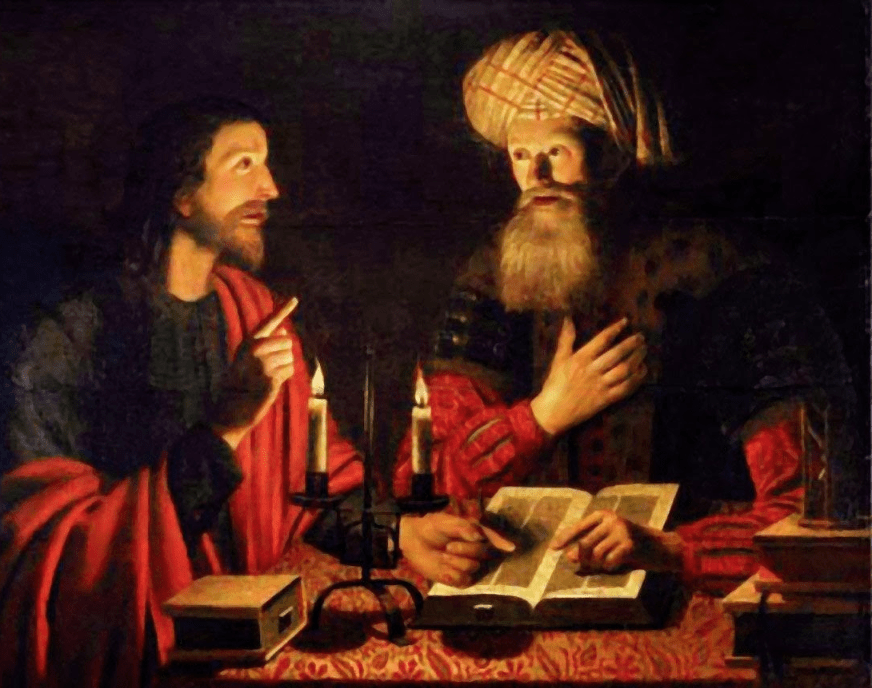
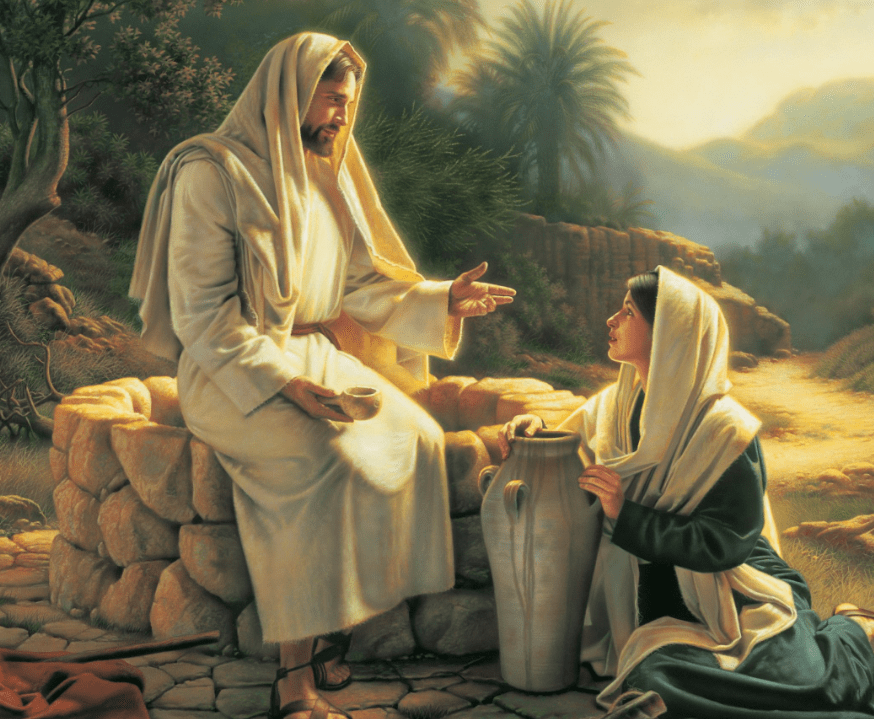
Nicodemus and the Woman at Jacob’s well
Sometimes the Gospel is presented to us ‘in reflection’ showing us mirror-like images we can compare. The comparison leads us to a form of understanding that grows from meditation instead of mere instruction. For those seeking to have the much talked about “personal relationship with Jesus” such images —so abundant in the Gospel— are an opportunity to grow in the knowledge of Christ-Logos.
Compare these two passages:
Now there was a man of the Pharisees named Nicodemus, a ruler of the Jews. This man came to Jesus by night and said to him, “Rabbi, we know that you are a teacher come from God, for no one can do these signs that you do unless God is with him.” Jesus answered him, “Truly, truly, I say to you, unless one is born again he cannot see the kingdom of God.” (John 3:1-3)
and …
A woman from Samaria came to draw water. Jesus said to her, “Give me a drink.” (For his disciples had gone away into the city to buy food.) The Samaritan woman said to him, “How is it that you, a Jew, ask for a drink from me, a woman of Samaria?” (For Jews have no dealings with Samaritans.) Jesus answered her, “If you knew the gift of God, and who it is that is saying to you, ‘Give me a drink,’ you would have asked him, and he would have given you living water.” […] The woman said to him, “Sir, I perceive that you are a prophet. […] “I know that Messiah is coming (he who is called Christ). When he comes, he will tell us all things.” Jesus said to her, “I who speak to you am he.” […] So the woman left her water jar and went away into town and said to the people, “Come, see a man who told me all that I ever did. Can this be the Christ?” They went out of the town and were coming to him. (cf. the complete passage John 4:1-45)
There are several opposites presented to us:
- Nicodemus is “a ruler of the Jews” a respected man of wisdom and integrity but he comes to Jesus by night.
- The Samaritan woman is powerless in many ways, she is a woman, the daughter of a subjugated nation and a person of no esteem. The Jewish teachers considered Samaritan women as “menstruating from the cradle” meaning permanently impure. She comes to Jesus at noon and meets him by the well dug by Jacob (Jacob being the father of the tribes of Israel and one important ancestor of Jesus himself.)
When we think of Nicodemus and the Samaritan woman as opposites, we can infer a number of useful teachings embedded in those two individuals. Nicodemus is important in society, the woman is not. The man comes to Jesus under the cover of darkness in spite of having good knowledge of the potent message sent by Jesus’ miracles. The woman knows not a thing about Jesus and does not dare to talk directly to a Jew until Jesus basically orders her: “Give me a drink.” She dares to humbly ask why a male Jew would ask her for that simple favor. Somehow she knows the event is significant and her question elicits from Jesus a truly evangelical response: the “living water” of the Gospel is available even to lowly Samaritan women.
The true well of Jacob, leading the redeeming mission of Israel to be “a light to the nations” is there talking to her. Under the light of the midday sun, the Logos, the eternal source of light and life has come to her. The effect is instantaneous: the woman manages to convince the whole town to come to the well and hear the message of Christ. Instant true discipleship!
To that woman Christ reveals Himself as the Messiah: “I who speak to you am he.” Consider the fact that —up to that moment— Jesus had not revealed himself as the Messiah neither to his disciples nor to the leading religious authorities. (cf. Luke 18:14)
In comparison, Nicodemus comes to Jesus at midnight. He can’t afford to be seen as a possible follower of the Galilean Rabbi. His first statement implies some reticence to recognize Jesus. Nicodemus cannot understand why Jesus can do such wonderful works of God apart from the order and hierarchical leadership of Israel’s religious system. In Nicodemus mind there are some misgivings: fear of men in authority, fear of losing his place in society. The Woman at the well is experienced in total powerlessness, she has nothing to lose. Instead, Nicodemus has many things to lose as he approaches the Kingdom of God. That is why Jesus talks to him about being born again. Becoming a newborn baby involves renouncing to the idea that he has any useful knowledge, societal importance, the ability to understand God’s deeds, or any possessions worth anything.
Nicodemus defaults again and again to the material reality. He interprets the “born again” analogy as a return to his mother’s womb. Had he understood the spiritual level of Christ’s message, Nicodemus would have thought of a return to the true spirit of the Torah, the Law of Moses that the religious authorities had reduced to a mere list of practices and abstentions.
Having encountered Jesus, the “ruler of the Jews” returns to the darkness outside. Contrary to the Samaritan woman, Nicodemus will not declare the words of Jesus to others immediately. Instead, he will conceal for some time the fact that he has met the Galilean. His faith remains unborn, in darkness. He will accept Jesus later but that night he walks away from the only source of spiritual light available to him. His fears are greater than his love of God and truth.
St. John explains the matter perfectly:
“Jesus said to them, ‘The light is with you for a little longer. Walk while you have the light, so that the darkness may not overtake you. If you walk in the darkness, you do not know where you are going. While you have the light, believe in the light, so that you may become children of light.’ After Jesus had said this, he departed and hid from them. Although he had performed so many signs in their presence, they did not believe in him. This was to fulfil the word spoken by the prophet Isaiah:
‘Lord, who has believed our message,
and to whom has the arm of the Lord been revealed?’And so they could not believe, because Isaiah also said,
‘He has blinded their eyes
and hardened their heart,
so that they might not look with their eyes,
and understand with their heart and turn—
and I would heal them.’Isaiah said this because he saw his glory and spoke about him. Nevertheless many, even of the authorities, believed in him. But because of the Pharisees they did not confess it, for fear that they would be put out of the synagogue; for they loved human glory more than the glory that comes from God.” (John 12-35-43)
Jesus —the Great Light— loves humble people. He smiles and bestows grace on the downtrodden but he opposes the haughty. I for one believe that we will be visited by that Great Light soon. We may experience great darkness before the light of Christ shines again on our poor, oppressed world. But we can be absolutely sure of the ultimate triumph of the light:
“The light shines in the darkness, and the darkness did not overcome it.” (John 1: 5)
 Quod scripsi, scripsi