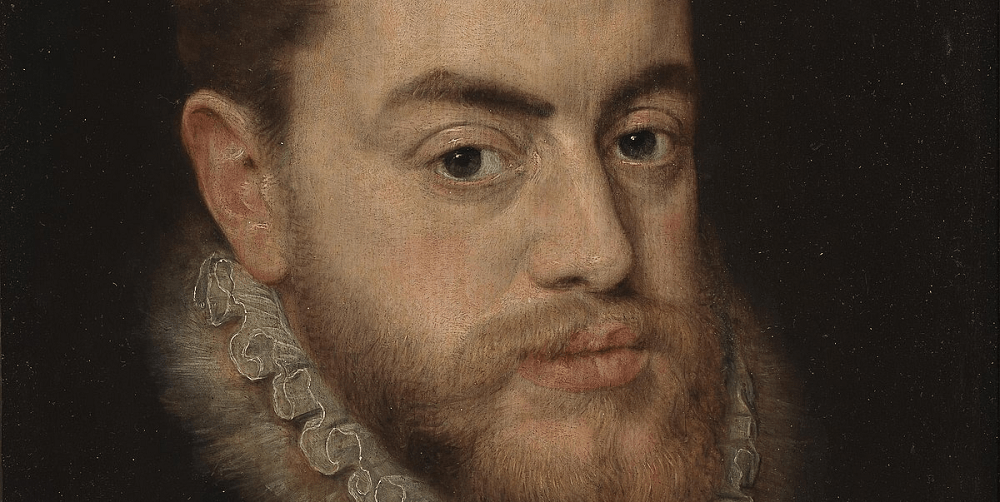
Omar Lopez Mato
He was one of the most powerful monarchs in history, despite his fragile health, and having endured the death of four wives and six children, in addition to that of his loyal half-brother, Don John of Austria, who achieved the victory of Lepanto, the battle that freed Europe from Islamic rule.
A pious, upright and orderly man. Despite his virtues, a legend was built around Philip II as black as the clothes he liked to wear. Although he was prince consort of England (married to Queen Mary I of England, sister of Elizabeth I), his former subjects did not miss the opportunity to attribute all possible evils to him, from ordering the murder of his son, Don Carlos (a lie eternalized by Verdi’s opera of the same name), until the catastrophic defeat of the Great Armada, with which he planned to invade the nation led by his former sister-in-law, known as the Virgin Queen. This failure and the frequent rebellions of its subjects, both in Europe and in America and its colonies in the Pacific and the eternal fight against Islamists and Protestants, led to enormous expenditures that led the Empire to default three times, causing the most vulnerable bankers to stagger. powerful in Europe.
And despite these failures with which he went down in history, his subjects called him “the Prudent King”, and he was… What were not so much so were his officials, who insisted on converting the Spanish empire in the more corrupt empire of universal history. Many of the defects of Latin American democracies find their reason in this heavy inheritance.
But the intention of this note is to recount the final days of this monarch, who, despite having suffered from possible congenital syphilis, asthma, arthritis, gallstones, prolonged fever syndromes and gout since the age of 36, managed to live 71 years, which, For the time, it was an advanced age.
However, the severe and strict education that he had received, added to an obsessive personality that loved routine, punctuality, and personal hygiene, allowed him to maintain an orderly and methodical life, which is, in part, the explanation of why he came to live such a long life.
His final psychological blow was the death of his beloved daughter Catalina Micaela, which led to depression and a worsening of his gout. This alteration of uric acid metabolism is hereditary. His father, Charles I of Spain, had already suffered several attacks of gout and was immobilized by gouty attacks in the joints.
At that time, the relationship between consuming red meat and and the metabolism of uric acid was not known, but they knew the relationship between the intake of alcohol, such as sherry wine, and the gout attacks that left the patient prostrate. In that century of lights without a refrigerator, sausages and cold cuts were the most common way to preserve food. Hence, Philip II’s problems worsened over time due to the diet he followed in the palaces.
With his symptoms exacerbated and aware that the end of his days was approaching, he asked to be transferred to the Monastery of Escorial. From his bed he could listen to Mass and contemplate his favorite painting, “The Garden of Earthly Delights” by Hieronymus Bosch, a work that made him meditate on the pains of hell and the joys of paradise, to which he would surely have access due to his pious life, his defense of faith and for the number of masses that were prayed for his soul (no less than 60,000).
In those days, tormented by pain and stinking-smelling pustules (perhaps what tormented him most as a man accustomed to meticulous personal hygiene), he asked that his father’s tomb be opened. The reason for such a strange request was that he wanted to copy down to the smallest detail how his mother had been shrouded so that his gravediggers could reproduce this rite exactly.
Almost unable to move, Felipe’s right hand was paralyzed and the doctors forbade him from taking communion because they believed he could choke by swallowing a host. He took his last communion on September 8, 1598 and, in a small room that allowed him to contemplate the main altar, he prepared to die.
In this last ordeal he called his children and before the future monarch, while reduced to a pitiful state of pustules and sores, he told them: “You will be present so that you can see what the kingdoms and lordships of this world come to.”
He died on Sunday, September 18 at 5 in the morning with a Crucifix in one hand and a candle in the other. He did not die attacked by lice as the black legend that still haunts him insists on condemning him, but with the peace of a good Christian who died in the faith of his ancestors.
Omar Lopez Mato
The original article in Spanish was published in La Prensa, Buenos Aires.
 Quod scripsi, scripsi