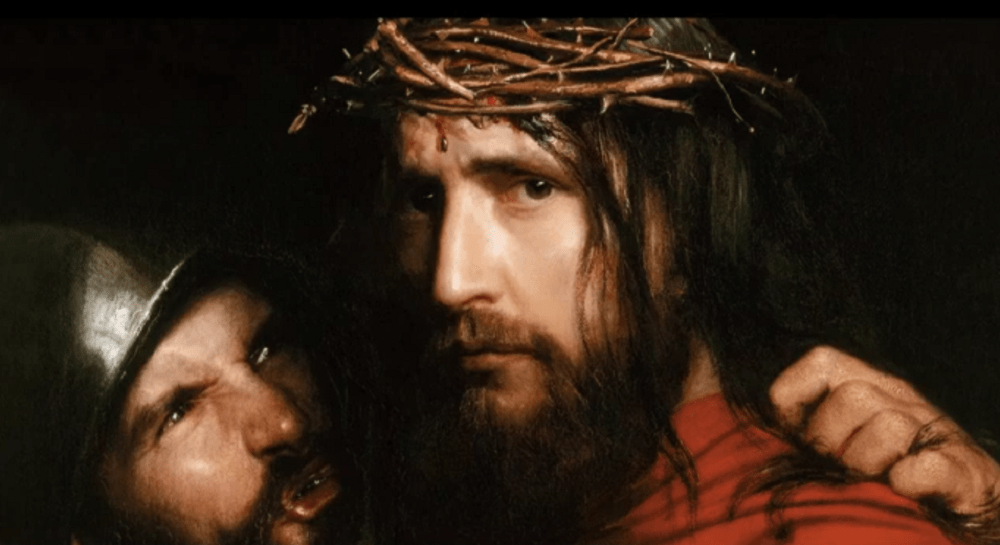
I am sure I am not the only one who looks at the Church and sees the dry tree that Jesus is mentioning here. Notice the context: Jesus said that on the way to Calvary.
We do well in reading Scripture as a prophetic model. In many other articles posted in this blog I discussed with my good readers the arc of the papacy walking through history. That is what I see represented in the life and ministry of Peter and his successors. Matthew 16 begins with Peter talking with God, receiving an extraordinary mission of clearly divine origin but … the conversation with Jesus ends with a strong admonition: Peter is compared to, and called a satan, a resister. Our poor first Pope descends quickly from divine favor to divine condemnation.
Christ ascends from Jericho to Jerusalem in a different manner. His Passion has a definitely ascending tone. He is “lifted up” on a Roman cross so He can call everyone to Himself. The whole affair is awash in humiliation and pain. Those expecting the Messiah were not counting on that. They did not count on that glory to be invisible to the human eye.
Peter had a similar experience as I like to point out: Peter’s Crucifixion mirrors Christ’s. The strange allegory of the letter Aleph is repeated one more time: “on earth as it is in heaven” Christ is in heaven and Peter is on earth. Both are crucified. With that figure we are introduced to the passion of the Church.
What happened to Christ will happen to the Church. Luke 23: 31 “For if people do these things when the tree is green, what will happen when it is dry?” The phrase reveals that Christ is the beginning of the suffering Church, His Passion naturally grows in history where His Mystical Body resides as the militant Church.
At the very end of that process, the Church suffers just as Our Lord suffered. It is a mystical body approaching a mystical end. That is what the vision of Fatima reveals: Christians dying a sacrificial, penitential death under a heaven that seems to demand penance.
There is no need to be a theologian to understand the painful, embarrassing news coming from the Church hierarchy these days. That is our shame, our suffering. God seems to want the world to contemplate in the Church what the inhabitants of Jerusalem witnessed when the Crucifixion occurred.
From the depths of history Jesus seems to ask each one of us if we are going to share the shame and pain that He endured.
The Cross is the only way we have to conquer the world forever.

 Quod scripsi, scripsi