
As they approached the village to which they were going, Jesus continued on as if he were going farther. But they urged him strongly, “Stay with us, for it is nearly evening; the day is almost over.” So he went in to stay with them. (Luke 24:28-29)
We have mused about the Aleph many times before. I was trying to fall asleep and failing when I thought again about the Aleph. Two ideas or images came into my mind almost at the same time. One had to do with the horizontal and vertical natures of the Aleph. I will explain later. The other image surprised me: it was not apparently connected to the first. That was the image of the prophet Jonah crossing Nineveh on foot. My mind’s eye focused on the man crossing an almost impossibly wide and long city. At that point I saw the figure of that lonely man surrounded by hostile strangers as a figure of Christ crossing history.
This strange conjunction I attributed to being in that twilight between being awake and fully asleep. But the whole thing bothered me in the way certain cats bug us incessantly until we give them our full attention. So… I gave it my full attention and I am here, sitting at my desk at midnight writing another pajama post.
The Aleph is a letter that apparently evolved over time. It started as the head or the horns of an ox. Our ancestors often associated the alphabet with plowing. I wonder why. The ancient way to write the Greek language was called boustrophedon, “as the ox plows.” That is a mode of writing that consists in one line reaching the right edge of the page and then going to the next line in reverse until the left edge was reached. Strange but it is somewhat connected to the original aleph by a factor of moo. Forgive the bad joke.
The letter took the form of the idealized representation of the ox’s horns, later acquiring the form of a plow that survives in our own letter “A”. What does this have to do with Luke 24:28-29. Nothing yet. You may be inclined to send me back to sleep —I don’t blame you— Somehow this will make some kind of sense in the end. I am not sure if it is I who is writing this stream of consciousness piece.
So the letter Aleph has a “horizontal” nature. That of a man plowing a field. Observe the classic shape of the letter. There is the plow if you want to look at it that way …

And then is the little man pointing at Heaven with his right hand while pointing at Earth with his left hand. That would be (in my deranged mind) the “vertical” nature of the Aleph. Do you remember that Christ has two natures? But that may have nothing to do with the letter. It is just a coincidence. The idea that the shape of the letter conveys is: “on earth as it is in Heaven”. Ain’t that something!
What about the image of Jonah crossing that huge city in Assyria? That city where he had been sent originally although he did not want to go at first. Compare now with Luke 24:28-29. Jesus was “inclined to keep on going …” but He (reluctantly?) stayed and later revealed Himself in the breaking of the bread.
We do not know what happened to the Ninevites but they repented en masse. We know there was a solar eclipse and other events. That may have moved them to heed Jonah’s preaching but we really do not know. The thing is, God had mercy on them much to the chagrin of Jonah who had to go through the belly of the fish and was vomited ignominiously on the beaches of Assyria when all he wanted was a vacation in Spain. Here is that tension between divine mercy and divine justice. God punished Jonah until he understood that his mission was not optional. Perhaps God wants to make us think with Jonah’s story. He is certainly making me think!
The “day” was almost over for Nineveh in the days of Jonah. The days of the Hebrew faith were almost over that Nissan 17th when the disciples met Jesus at Emmaus and He was Eucharistically revealed to them for the first time in history! The road to Emmaus appears to be a picture representing history.
So the Aleph has a horizontal sense, like a plow. And a vertical sense like the invisible roads between Heaven and Earth that angels thread sometimes. Like the Cross, it has two parts: one horizontal and one vertical “on earth as it is in Heaven”. Now compare that with the words of Jesus to Peter:
I will give you the keys of the kingdom of heaven; whatever you bind on earth will be bound in heaven, and whatever you loose on earth will be loosed in heaven.”
(Matthew 16:19) But, wait a minute. Didn’t Jesus call Peter “Son of Jonah”? Perhaps because the fisherman was (like Jonah) a bit reluctant to accept his mission even to the point of rejecting his Master (see Luke 5:8; John 18:15-27.) Jonah was thrown out of the boat but Peter stayed on his boat. Without even knowing the profound meaning of his words he said “I’m going fishing!” even after Calvary had shattered all his hopes.
Back to Jonah crossing Nineveh.
“Now Nineveh was a very large city; it took three days to go through it.” (Jonah 3:3)
Three days? Three millennia? Notice the similarities with Christ. Please remember the words of St. Josemaria Escrivá; “Christ is passing by!” and the words of the disciples enticing the Traveler to stay at the Inn:
“Stay with us, because it is almost evening and the day is now almost over.” (Luke 24:29)
Read on …
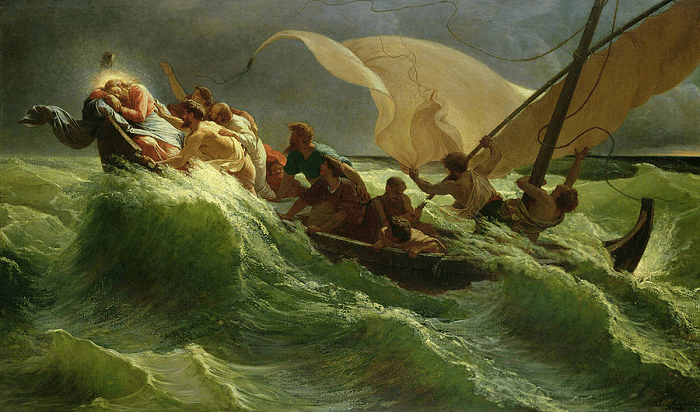
Then the Lord sent a great wind on the sea, and such a violent storm arose that the ship threatened to break up. All the sailors were afraid and each cried out to his own god. And they threw the cargo into the sea to lighten the ship. But Jonah had gone below deck, where he lay down and fell into a deep sleep. The captain went to him and said, “How can you sleep? Get up and call on your god! Maybe he will take notice of us so that we will not perish.” (Jonah 1: 4-6)
On that day, when evening had come, [Jesus] said to them, ‘Let us go across to the other side.’ And leaving the crowd behind, they took him with them in the boat, just as he as. Other boats were with him. A great gale arose, and the waves beat into the boat, so that the boat was already being swamped. But He was in the stern, asleep on the cushion; and they woke him up and said to him, ‘Teacher, do you not care that we are perishing?’ (Mark 4: 35-38)
I leave the similarities to your discernment: “the day is almost over” (the End Times) and also the “storm” that the Church is experiencing right now because we (like Jonah) have grown weary and fearful to face the world and fulfill our mission which is to give witness of Jesus the Truth.
Perhaps tomorrow, I will try to explain the last part of these strange thoughts that came up to me while I was innocently trying to fall asleep: perhaps the time of reckoning is approaching for those who originally rejected the transcendental mission of Israel saying: “we have no king but Caesar!” (John 19:15)
“The day is almost spent …” And “My house will be called a house of prayer’ for all nations…” Christ is passing on by the road of history. This is our time and the time for those who rejected Him to accept Him. For there will be no salvation through anyone but Him.
 Quod scripsi, scripsi
IN RESPONSE TO ANONYMOUS
On Mon, Nov 6, 2023, at 4:22 PM, Carlos Caso-Rosendi wrote:
The blood and water issue from the Cross, that is the intersection of the temporal and the eternal. Three days to “cross” the city from Good Friday to Glory Sunday. The three days of Jonah in the belly of the fish. Three millennia to complete the cleansing of the Earth from the Nativity to the Final Judgment. Peter as reflection of Christ: the Divine Singularity touches in reflection the created singularity “Tu est Petrus” the Living Spirit touches the barren matter to renew the Earth.
In the midst of all that, Christ is “inclined to pass them by” at Emmaus and the reflection is found in Jonah’s reluctance and in Peter’s cowardice, they repeat the dance (I’d pass you by but I won’t) in the Via Apia: Peter is trying to escape the Cross just like Jonah but Christ gently reminds Peter that the Cross is the right seat of love, the Cross is the wonderful point of transcendence, a cosmic gate to the vertical realm beyond, the place where the failing human nature can acquire the divine qualities. There is simply no end to this whirling mandala of meaning where we understand and we are befuddled at the same time. Peter finally understands and asks to be crucified upside down with his formerly reluctant feet now willing to thread the eternal above.
The Aleph can be seen in the Borgesian sense as the center of the universe: a Man-God crucified. Stat Crux dum volvitur orbis. God setting up a fixed point so the universe shattered by sin can begin to recompose according to the Divine Purpose.
LikeLiked by 1 person
RECEIVED VIA EMAIL
On Mon, Nov 6, 2023, at 2:58 PM, Anonymous wrote:
You should offer your pen to inspiration more often in the midnight hour. Your pajama post is well written and fascinating.
I have finished [reading] Mathew and Mark and begun Luke. So all of this is very fresh in mind. Last night I toyed with the idea that in all of history there can only be one incarnation. This may sound self-evident, but I found plenty to pick at and turn over. History is the horizontal and eternity is the vertical. The vertical sees all of the horizontal, but to the horizontal, the vertical is a singularity, and a point.
The three days crossing Nineveh is also three days in the earth, or in the bars of the earth or behind the gates of hell. Peter BarJonah is the vicar of Christ on earth. Of course he must be part of the sign of Jonah, which is the master sign given to a stiff necked generation. The more one looks, the more there seems to be to see.
Jesus on the cross – nailed to the vertical at his feet, points with each nailed hand to the horizontal. Perhaps one hand points to the Old Testament and the other to the New Covenant. Tradition says that His right side was pierced by the spear. The blood and water was the sign of the new Church. One could almost say the “right side of history”.
LikeLike